Belonging: Migration and Human Rights in Australia
Author: President Hugh de Kretser Date: 1 October 2026 Location: Sydney
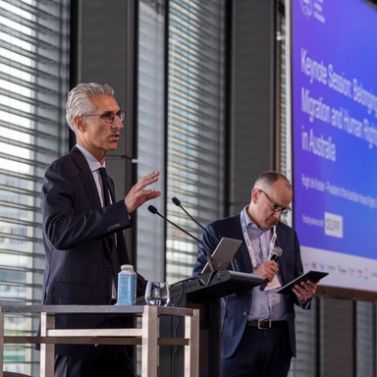
Speech summary
- Author: President Hugh de Kretser
- Date: 01 October 2026
- Location: Gadigal land, Sydney, New South Wales
Migration is, at its heart, a deeply human story. It is about people seeking safety, opportunity and belonging.
It is about people and families making profound decisions about their future, often in circumstances of uncertainty, vulnerability or hope.
Because migration is fundamentally about people, it is also deeply connected to human rights.
Human rights aren’t earned through citizenship, nationality or migration status.
They belong to every one of us, no matter who we are, or where we are, by virtue of the mere and vital fact that we are human.
Citizens, permanent residents, temporary visa holders, people seeking asylum, refugees, stateless persons – are all entitled to have their human rights protected.
This principle sits at the heart of international human rights law and it provides an essential foundation for migration policy.
This morning I’m going to talk about:
- This history of migration and multiculturalism in Australia
- The rise in anti-migration sentiment
- The need to defend multiculturalism and build belonging for all, and
- Why human rights standards are essential for fair migration policies.
I’ll also draw on my own family’s migration history.
First Peoples
We are here on Gadigal land – I acknowledge Gadigal elders and ancestors and their Eora Nation neighbours.
I acknowledge their ancient and unbroken connection to the country we are on and their continuing culture.
When we talk about migration in Australia, the starting point is remembering that Australia’s First Peoples have occupied this continent for over 60,000 years.
If those thousands of generations were represented by the distance from Sydney to Melbourne, the period since European colonisation in 1788 would take us only from the Sydney CBD to the SCG.
That perspective should bring humility to every Australian debate about who belongs here.
When Europeans arrived, there were hundreds of diverse tribes or nations across the continent and its adjacent islands with hundreds of languages and dialects, from the Noongar in the south west to the Larrakia in Darwin to the Palawa in Tasmania.
They are Australia’s First Peoples and they have special status under international human rights law and Australian law as Indigenous peoples.
Migration and multiculturalism are essential parts of Australia’s national character
I watched the film The Holdovers on the weekend. It’s an entertaining, funny and poignant film about a history teacher.
At one point he says ‘If you truly want to understand the present or yourself, you must begin in the past. You see, history is not simply the study of the past. It is an explanation of the present.’
It’s good to see you’ve got Mark Cully on the program tomorrow talking about his new book on Australia’s immigration history.
I want to start today by briefly covering some history.
Australia’s migration and multiculturalism story started before the First Fleet.
It was mainly the Dutch who mapped most of Australia’s coast, naming places like Arnhem Land and Rottnest Island - but apart from shipwrecks, they didn’t stay.
People from Makassar in Sulawesi came to northern Australian seasonally for around 200 years from the 1700s, setting up semi-permanent camps to harvest trepang – sea cucumber – which they processed and sold to China.
They traded with Aboriginal people across our north coast until the annual migration was effectively banned by Australian governments under the White Australia policy and the last boats left in 1907.
The First Fleet in 1788 marked the start of European colonisation. It included people of African descent and Jewish people.
Most new arrivals after the First Fleet were British.
This is the story of my earliest Australian ancestor on my mum’s side, Adam Rutledge, who arrived in Victoria from Ireland in the 1850s.
From the mid-19th century, thousands of people from South Asia and the Middle East were brought here to work as cameleers transporting goods across our outback before roads or railways.
Their legacy is referenced in the name of the famous Adelaide to Darwin train, originally called the Afghan Express then shortened to the Ghan.
The gold rush brought miners from across the world including tens of thousands of Chinese people, at one stage making up around 3% of our population.
The 1854 Eureka Stockade was a defining moment in Australia’s history, famous for the miners’ fight for democracy and equality.
Their uprising was also a profoundly multicultural movement and their flag was a flag of inclusion and unity. It’s so frustrating to see it used at anti-immigration rallies by people ignorant of its history and meaning.
People from over 20 countries were involved in the Eureka uprising including from Ireland, Italy, Finland, France, Canada, Germany, Poland as well as Jews and African Americans.
One of the miners, Raffaello Carboni, wrote ‘I [called] on all my fellow-diggers, irrespective of nationality, religion, and colour, to salute the Southern Cross as the refuge of all the oppressed from all countries on earth.’
In response to claims that the Eureka rebellion was caused by 'foreigners', the Editor of the Ballarat Times wrote, 'Anyone who immigrates into this country...and contributes towards the development of its resources and its wealth, is no longer a foreigner...The latest immigrant is the youngest Australian.'
In the 1860’s, tens of thousands of workers were brought to Australia from the South Pacific to work on Queensland plantations. Many were forced or tricked into coming. They lived and worked here in harsh slave-like conditions. The trade became known as ‘blackbirding’ and it ended in 1901 with the White Australia policy. Many South Sea Islanders were deported but thousands remained.
In the lead up to Federation, the drafters of the Australian Constitution, the rule book for the new nation, debated whether to include human rights protections in the document.
They expressly rejected equality protections because they did not want to give equal rights to First Peoples or others with dark skin.
Our Constitution today still has wording contemplating that people could be denied a vote based on their race.
After Federation, the White Australia policy was implemented, primarily through the Immigration Restriction Act of 1901.
This was a law that sought to define who belonged here and who should be excluded.
It was premised on the poisonous idea that some humans are worth less than others.
The Act gave immigration officers the power to make any non-European migrant sit a now infamous 50-word dictation test.
As the language chosen for the dictation test was at the discretion of the immigration officer, it was easy to ensure failure for migrants deemed undesirable.
As Prime Minister Alfred Deakin said in 1905, “the object of applying the language test is, not to allow persons to enter the Commonwealth, but to keep them out”.
It was perhaps most infamously used in 1934 to try and prevent the migration of Egon Kisch, a Czechoslovakian communist, anti-war and anti-fascism activist.
Kisch spoke several European languages so the immigration official gave him the test in … Scottish Gaelic. He failed the test but successfully challenged it in court.
The White Australia policy had a significant impact.
The small Asian population in Australia shrank and by 1947 only 2.7 per cent of the Australian population was born outside of Australia, Ireland or the United Kingdom.
Into this policy setting, my father’s family migrated from Sri Lanka, then called Ceylon, in 1949. They became citizens in 1952.
This side of my family are Dutch Burgher Sri Lankan. The Burghers are the descendants of Portuguese and Dutch settlers in Sri Lanka who, over centuries became of mixed European and Sri Lankan descent.
Under the White Australia policy, my grandparents had to prove they were “predominantly European” by lodging their genealogy with the High Commission in Colombo.
The High Commission thought the Dutch Burghers would make suitable Australian citizens. But the arrival of “European” Sri Lankans with non-European appearances caused consternation.
In 1951 the Department of Immigration in Canberra told the High Commission in Colombo it: “should not authorise the entry of persons who are likely to cause adverse comment on arrival or be restricted from landing by immigration officers at the ports as being predominantly non-European in appearance.”
Some Burghers with darker skin or less European ancestry had their migration applications refused.
The White Australia policy was finally dismantled in the 1960s and 1970s and in 1975 the Whitlam Government passed the Racial Discrimination Act and brought in policies of multiculturalism.
There has generally been bipartisan support for non-racially discriminatory migration policy since.
The point of talking about this history today is threefold:
- Firstly, we can’t talk about migration without acknowledging First People’s ancient and ongoing occupation of this continent.
- Secondly, Australia has a long multicultural history that predates the White Australia policy and even British colonisation.
- Thirdly, we must learn the lessons of the injustice of the past and never return to racially discriminatory migration policies.
Migration debates today
Today of course Australia is incredibly multicultural and migrant. Around a quarter of us were born overseas and half of us have a parent born overseas.
Scanlon Foundation and Lowy Institute surveys repeatedly show very strong support for multiculturalism in Australia.
Australians know that diversity makes us stronger.
But surveys also show that a majority of Australians think migration numbers are too high and support for cultural diversity has dropped.
It’s in this context that current public and political debates have been focussed on ways to limit migration.
It is of course perfectly fine to debate the number of people who come here, the composition of the migration program, and the impact of migration – both positive and negative – on services and infrastructure.
But at times these debates have dangerous undercurrents and sometimes explicit racism.
Migrants are being unfairly blamed for social and economic problems.
Particular racial and religious communities are being singled out.
And belonging is being said to be conditional on ethnicity.
Attacks on migrants and multiculturalism do harm.
They fuel racism and hate and division in our community.
They increase the risk of violence.
They damage belonging and unity.
Multiculturalism affirms that belonging is not defined by race or ancestry
My dad’s Sri Lankan migrant background has been a gift to me.
It’s made my life richer and helped me make connections here in Australia and across the world.
I don’t want to overemphasise this – I grew up in an English-speaking, Christian household with an English first name and a Dutch surname.
But my multiracial background has given me insight into the importance of belonging, of pride in racial identity and of the need to address racism.
It has shaped me in different ways throughout my life.
As a child growing up in Melbourne's eastern suburbs, I always felt deeply Australian. But I was also self-conscious of looking different from what many people saw as the Australian norm.
Then, at 21, I was travelling on a long distance train in Europe with three fair-skinned friends. Police entered our carriage and asked to see only one of our passports.
A few years later, I travelled to Sri Lanka for the first time. Staying with relatives and experiencing that side of my family's story, many things suddenly made a lot more sense.
Those experiences were different, but they were all valuable lessons.
Belonging, pride and identity matter.
It’s why we need to defend multiculturalism.
It’s why we need to embrace a unifying concept of being Australian, that encompasses the descendants of Chinese gold rush miners, the South Sea Islanders brought here in the 1860’s, that encompasses the Jews who fled Nazi Germany, the Eastern Europeans who came after the war and the South Asians who’ve arrived more recently.
It’s why we need to treat the White Australia policy like the toxic waste that it is and bury it deep underground.
Multiculturalism is not something to be justified.
It’s not a concession or favour to be granted by some Australians to others.
It is not an experiment that remains permanently under review.
It is who we are as Australians.
It is our fabric.
Our strength. Our unity.
And it belongs to all of us – and our children.
I want to finish by talking about Australian values and the relevance of human rights to migration policy.
Australian values and human rights
We often hear that migrants must accept Australian values.
I don’t mind this debate.
Because when we look at what Australian values are, the path leads to human rights.
And people and governments should uphold human rights.
And we should have a shared Australian identity around human rights.
This identity should recognise that many of our human rights values have roots in important British democratic and legal traditions; parliamentary democracy, an independent judiciary and the rule of law.
Australia has taken these traditions and improved on them, particularly in relation to democratic innovations.
Our citizenship booklet talks about what our shared values as Australians are.
It says: Australians believe in shared values such as the dignity and freedom of each person, equal opportunity and the rule of law.
It talks about democracy, freedom of speech, freedom of association, freedom of religion, gender equality and rejecting violence.
It describes Australia as a stable and successful multicultural nation.
New Australian citizens must make a pledge saying:
I pledge my loyalty to Australia and its people,
whose democratic beliefs I share,
whose rights and liberties I respect, and
whose laws I will uphold and obey.
That pledge cannot run in only one direction. If equality, freedom and a fair go are Australian values, our governments and institutions must uphold them too.
Australian values should not just be a rule for newcomers. They are standards by which all of us, including government, should be judged.
I worked for 2 years at the Yoorrook Justice Commission – Australia’s first formal truth telling inquiry into historic and ongoing injustice against First Peoples in Victoria.
It changed my world view and helped me see things from an Aboriginal perspective.
I wonder how Australian values might be expressed in our citizenship booklet if it was written from an Aboriginal perspective?
Seen through a First Peoples lens, Australian values might also include caring for Country, living sustainably, respecting elders, celebrating culture, strong family and community connections, and sharing what we have.
These are also Australian values worth subscribing to.
And when I hear migrants criticised for not speaking English properly or fitting neatly into Australian culture, I often think about how that sounds to Aboriginal and Torres Strait Islander people – who have had their language, culture and traditions suppressed and displaced over the past two centuries.
It’s a perspective that for me, reinforces the need to promote inclusion and belonging for all, within a unifying multicultural Australian identity.
Migration policies that uphold human rights
So how do we measure our migration policies against human rights standards.
Human rights impacts occur in every facet of migration – from border control, visa decisions and detention, through to access to healthcare, education, housing, social security and conditions of work.
Governments exercise significant power and control over the lives of migrants.
This makes accountability for that power, and compliance with human rights standards, even more important.
In Australia, migrants are often vulnerable to, and experience, human rights violations.
Their experiences are often shaped by intersecting factors including race, gender, disability, age, sexual orientation, religion and economic hardship.
International human rights law provides a vital framework to ensure that government power in the context of migration is exercised fairly, lawfully and with respect for human dignity.
Australia has voluntarily committed itself to international human rights treaties and other standards.
We did so because it’s in our national interest that there are minimum global standards or rules to ensure that every person has the chance to lead a decent, dignified life.
Some human rights are particularly relevant in the migration context.
These include the right to equality and non-discrimination, the right to life, to safety, to freedom from arbitrary detention – or in plain language not being locked up unfairly.
There are human rights concerning equality before the law, the right to fair hearing and a specific right concerning due process before any deportation.
There are economic and social rights including rights to education, employment, health and to an adequate standard of living which includes adequate housing. These rights are integral to ensuring that migrants can participate fully in Australian society.
There is the right to just and favourable conditions of work. This is particularly important in the Australian context given the evidence of exploitation and unsafe working conditions for many migrant workers.
Migrants make critical contributions across Australia's workforce and economy, from healthcare and aged care to agriculture, construction and technology.
A human rights-based approach to migration recognises that ensuring decent work, fair treatment and access to remedies benefits workers, employers and the broader community alike.
There are rights protecting families and children which require that decisions that interfere with family life should not be arbitrary and should be reasonable and proportionate in the circumstances.
Finally, there are specific rights protecting refugees and people seeking asylum – people fleeing harm. These include the right to seek asylum and the rights not to be returned where there are risks of serious harm or death.
As Australia moves towards limiting migrant numbers and more aggressive polices to remove people without a valid visa, the risks around breaching these human rights standards increase.
Put another way, the importance of protecting the human rights of migrants becomes more acute.
Conclusion
Australia is a migrant nation on the ancient lands of First Peoples.
People who have migrated to Australia over the generations – who have chosen to build a life here and call this place home – have made enormous contributions.
Migration has made Australia stronger, socially and economically.
It has fuelled our Australia’s success.
It is a core part of who we are.
Our history contains extraordinary stories of welcome and belonging. It also contains stories of exclusion, racism and of lives harmed by government policy.
We’re at a challenging time for migration with anti-migration sentiment rising and moves towards reducing the number of people migrating here.
We must debate migration without demonising migrants.
We must defend Australia’s multiculturalism as a core part of our nationhood.
And we must foster a sense of belonging for all members of our community.
Human rights standards support effective migration management. They provide a framework for ensuring that migration systems are fair, lawful and centred on human dignity.
Human rights standards remind us that behind every visa application, every policy debate and every administrative decision is a human being, entitled to be treated with dignity and respect.
A migration system that upholds human rights is not only better for migrants. It is stronger, fairer and better for all of us.
Hugh de Kretser
President