National Access to Justice and Pro Bono Conference
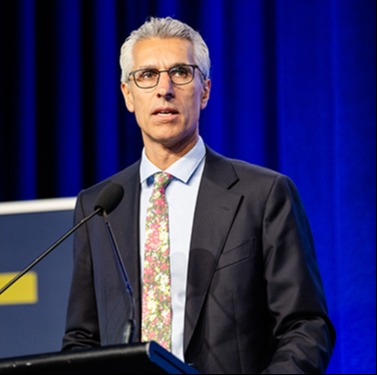
Hugh de Kretser speaks about the worsening overimprisonment of First Peoples, despite decades of recommendations and government commitments, at the National Access to Justice and Pro Bono Conference 2025.
Speech summary
- Author: President Hugh de Kretser
- Date: 30 October 2025
Back in 2013, I was at National Community Legal Centre Conference in Cairns. A Yidinji man, Murrumu came up to me at the conference to talk about human rights and constitutional law issues. Then he gave me some advice – he said I’d learn more by getting out of the conference and going down to the Cairns Magistrates Court where in his words, ‘blackfellas are getting thrown to the wolves’.
I took his advice and went down with Tania Wolff and Melissa Hardham and sat and watched the criminal list for the morning.
I did learn. And what I saw was both depressing and infuriating.
All of the defendants except for 1 were First Peoples.
I saw a justice system going through the motions - meting out punishments to First Peoples who had committed offences who had backgrounds of deep disadvantage including disabilities like cognitive impairment and hearing loss.
There was a strong sense of inevitability that the punishments would do nothing to address the underlying causes of offending.
An underlying certainty that the same people will reappear in court for more of the same inflexible approaches and many will end up in police cells or jail.
I knew all of this already. I’d worked in prisons and with victims of crime and advocated for years for smarter criminal justice policies.
But that visit for me was a stark reminder that our justice system is not working as it should – especially for First Peoples.
That was 12 years ago. Many things have got worse since.
The rate at which Australian governments are imprisoning Aboriginal and Torres Strait Islander people is one of the greatest injustices in Australia today.
We need to change course. This is what I want to talk to you about today.
It’s so good to be here to speak to you amongst so many friends.
Access to justice and pro bono work has been central to my career.
We know that access to justice is about much more than access to lawyers.
It’s not access to justice to receive accurate legal advice that what happened to you is unfair, but perfectly legal.
True access to justice is about making sure our laws and policies deliver justice for all. It’s about ensuring our justice system lives up to its name.
Thank you all for the important work you are doing to help achieve this.
To the pro bono lawyers, law firms and barristers I’ve worked with over my career, from the Brimbank Melton Community Legal Centre to the Human Rights Law Centre and beyond – thank you for your support for our work.
We’re on Wurundjeri country. I acknowledge their elders and ancestors. Their ancient and unbroken bond with this country. And their enduring strength and culture. I also acknowledge their Kulin Nation neighbours, the Bunurong Boonwurrung and all First Peoples here.
Let me start with some scene setting.
It’s 1991 and the Royal Commission into Aboriginal Deaths and Custody is handing down its landmark final report.
The key finding of the report is that Aboriginal people are dying at high rates in custody:
... not because Aboriginal people in custody are more likely to die than others in custody but because the Aboriginal population is grossly over-represented in custody. Too many Aboriginal people are in custody too often.
The Commission said that the rate of Aboriginal imprisonment and deaths in custody would not be tolerated if it occurred in the non-Aboriginal community.
The Commission’s report didn’t just look at the individual deaths it investigated, it identified the larger social and economic factors to explain them.
It didn’t just look at the criminal justice system, it went beyond to examine why Aboriginal people were coming into contact with police and being locked up in police cells and prisons at higher rates.
It highlighted the disadvantage that drove imprisonment.
It highlighted the connection between colonisation and that ongoing disadvantage.
It highlighted the need for self-determination to address that disadvantage.
The Royal Commission delivered 339 recommendations. Some were targeted at criminal justice reforms to address deaths in custody. Some were targeted at overimprisonment. Many were much broader.
The Commission said:
The principal thrust of the recommendations, as of the report, is directed towards the prime objectives--historically linked--of the elimination of disadvantage and the growth of empowerment and self-determination of Aboriginal society.
The key takeaway from the report was that if we want to stop Aboriginal people dying in custody at higher rates, we need to address the factors that cause governments to lock up Aboriginal people at significantly higher rates than non-Aboriginal people.
What has happened since the Royal Commission delivered its findings and recommendations?
The rate of Aboriginal and Torres Strait Islander overimprisonment has got worse.
In June 1991, there were 2,213 First Peoples imprisoned in Australia.
In June 2024 there were 15,871.
Even accounting for population increases and higher rates of people identifying as Aboriginal and Torres Strait Islander, this is a massive increase.
Over 600 First Peoples have now died in custody since the Royal Commission.
After advocacy by Change the Record and others, addressing this problem was added to the Closing the Gap targets in 2020.
Under the new Closing the Gap targets, Australian governments committed to take action to reduce Aboriginal and Torres Strait Islander adult imprisonment by 15% by 2031.
What has happened since?
The rate of overimprisonment has got worse.
The Closing the Gap dashboard shows that the imprisonment rate for First Peoples rose around 33% between 2016 and 2024.
It went up 15% in just one year between 2023 and 2024.
Most people locked up in our jails are adult men. But the rate of imprisonment of First Peoples women has been growing more rapidly with the gap between rate of imprisonment of Indigenous and non-Indigenous women higher than that of men.
It’s easy to get lost in numbers. The human impact behind these numbers is tragic. Lives broken. Communities torn apart. Hope destroyed.
In April, I was in the Territory with my colleague Aboriginal and Torres Strait Islander Social Justice Commissioner Katie Kiss. We visited two jails in Darwin and a prison work camp in East Arnhem Land. The Territory prison system is overcrowded and struggling to keep pace with the rate at which the government is locking up Aboriginal people. They’ve had to reopen the old Berrima Prison to try and cope – this was the Don Dale Centre at one stage – and it’s now full too.
It was good - and tragic - to talk to the men there – mostly young men locked up. Removed from Country across the Territory and warehoused behind the razor wire in Darwin.
So the critical question is, why is this happening, despite all the focus on the Royal Commission recommendations and the commitments of every Australian government to do the opposite?
There are many factors that drive imprisonment rates.
Crime rates are one factor but over the decades since the Royal Commission, many key rates have been stable or trending downwards. Homicide has dropped significantly.
One of the key reasons is about how governments and parliaments choose to respond to crime.
And one of the key statistics that shows this is the remand rate.
Bail is the system for allowing people who have been charged with an offence, who are innocent until proven guilty, to be in the community while they are waiting for their trial or sentence.
When someone is locked up on remand, they are waiting for their trial or sentence while imprisoned, often because they have been refused bail.
Governments across Australia have been proudly introducing harsher bail laws that are causing more people to be locked up on remand.
Prisoners on remand now make up over 40% of our national prison population, roughly double the percentage from 2 decades ago. The remand rates for women and for children who are imprisoned are even higher.
This is all because of how governments choose to respond to crime.
We know that prisons can be criminogenic - they can make it more likely that people reoffend on release. Around 40% of people released from adult prisons will return to jail within 2 years.
Prisons are ineffective at stopping reoffending. Yet governments increasingly turn to them as if they are the answer to crime.
So who is being locked up in our jails?
Most people – First Peoples and non-Indigenous - will never commit a serious crime and will never spend time in jail.
Back when I was working at the Federation of Community Legal Centres, then Victorian Attorney-General Rob Hulls gave me some good advice. He said to contact the Parole Board and sit in as an observer on one of their hearings.
I took up his advice and the Parole Board kindly agreed to have me observe.
Parole is the system of conditional release towards the end of a person’s prison sentence.
Judges, when sentencing someone for a crime, typically set a minimum non-parole period that must be served as well as a maximum sentence.
The Parole Board can grant someone conditional release after they have completed their minimum sentence – often after they have completed certain programs in prison as a condition of parole eligibility.
The best evidence is that supervised and supported release on parole reduces the risk that someone will reoffend. It is better for community safety than releasing someone cold at the end of their prison sentence.
Despite this, governments, including in Victoria, have moved to restrict parole – contributing to overimprisonment.
What I saw in that parole hearing was a bit like the other end of what I saw in that courthouse in Cairns.
A steady stream of people who had experienced multiple and serious disadvantage in their lives being considered for release.
The hearing time for each person was extremely short so things quickly blurred over the hours into a repeated themes of neglect and violence during childhood, disengagement from education, unemployment, homelessness, mental illness, disability, substance abuse and more.
Due to continued impact of colonisation, these factors are more present for First Peoples communities. So when more people are locked up on remand or serve more time in jail because they can’t get parole, this affects First Peoples more.
The takeaway from the parole hearing was clear. If we want safer communities, if we want to reduce imprisonment, we must address these issues.
This of course is what the Royal Commission said.
It is of course what criminologists know.
It is what the evidence tells us.
It was what all the inquiries tell us - Doin Time, Time for Doin, Pathways to Justice, the Yoorrook Justice Commission and more.
It’s also what the police tell us. There are good leaders in the police who recognise that we cannot arrest and lock up the social problems that drive crime, like underfunded mental health or drug and alcohol systems.
I remember watching recruit training at the police academy in Glen Waverley where they put up the de-identified police database record of a person with multiple offences.
All of the first contacts with police were not as an offender. They were as a victim starting from childhood. Over time the victim reports decreased and the offender reports increased.
These issues do not fit neatly into the mass media binary of deserving victim and undeserving offender.
So why don’t we do what the evidence tells us to do?
Governments would say that they do – and in some sense they are right.
There are programs to address all of these issues.
The problem is that when it comes to safety issues, governments tend to prioritise spending at the wrong end of the system – on police and prisons – when we know it is more effective and cost effective to focus on prevention.
And this is driven by the relationship between the mainstream media and law and order politics.
The for-profit mainstream media makes money by getting people to pay attention to media stories. This increases the likelihood they will run sensationalist stories about crime and portray sentences as lenient. This is despite that fact that evidence shows that when the public has facts about a particular crime, a very large majority agree that the sentence imposed by a court is appropriate.
Politicians then respond to the media stories and pressure by promising more police, more police powers and harsher punishments despite the evidence and their public servants telling them these measures will be less effective and possibly counterproductive than other measures.
This is happening across Australia now, but particularly in the Northern Territory and Queensland with measures such as:
- sentencing children as adults
- removing the sentencing principle of imprisonment as a last resort for children
- reintroducing mandatory sentencing
- making it harder to get bail
- lowering the age of criminal responsibility to 10
All of these things mean more people in prison for longer, with First Peoples disproportionately affected.
This means diverting available resources away from things that are proven to be effective in tackling crime.
So what do we do about this?
Violent crime is a human rights violation. We must address it. We must stop the murders, rapes, assaults and home invasions. We must make our communities safe.
That’s why it’s critical to do what has been proven to work.
We need to prevent crime rather than respond after the damage is done with blunt, harmful and often counterproductive measures.
We need a better, more informed public debate on these issues. We need the public to question policy priorities that abandon the evidence about what works in favour of lazy, non-solutions with labels like "name and shame", "boot camp", and "three strikes".
And this matters most for First Peoples communities.
They are more likely to be victims of crime – and violent crime in particular.
They need the best of the justice system and yet too often get the worst.
When we talk about community safety, we must mean community safety for the whole community – including First Peoples.
We know that only around 20% of people in prison finished high school. So we need to work harder to keep children in school.
For First Peoples - we need to ensure that our school system responds to their needs – that our schools are places where their children can be themselves, proud in their culture. We need to ensure our schools respond to the needs of children with disabilities.
We know that child neglect is a key driver of crime. So we need to support struggling families to grow their children up safe and healthy. We need to fix our failing child protection systems so that they shift focus to early support rather than harmful interventions when it’s too late.
We know that housing on release from prison is critical to lowering the risks of reoffending. We need to ensure stable housing with wraparound supports for people exiting prisons.
We need to ensure that time in prison is spent well – on health, skills and meaningful activity – and where possible, pathways to employment on the outside.
We know that connection to culture for First Peoples is critical to wellbeing and lowers the risk of reoffending.
None of these things slip off the tongue like ‘adult time for adult crime’ but we know they are the keys to safer, healthier stronger communities.
We need to do a better job on explaining this to the public. We also need to work with others to do this.
Here I note that the Institute of Public Affairs has just released a paper calling for prison reform. They point to the fact that Australian governments are now spending over $6.8 billion per year on the construction and operation of prisons which represents a 50 per cent growth in just 10 years when adjusted for inflation.
They say we should move away from locking up non-violent offenders and redirect the money towards crime prevention.
They call for low-risk, non-violent offenders to be contributing to society through work and paying back the victims of their crimes.
These are good ideas. We should back them.
And we need to back in First Peoples leadership.
There are good initiatives happening across the country and they are being led by First Peoples with steps towards the self-determination.
On Groote Eylandt and in Alice Springs in the Northern Territory there are programs that provide local, alternatives to prison that are showing promise.
The Australian Government has funded around 30 justice reinvestment programs across the country. These are community led initiatives to prevent crime and reduce contact with the criminal justice system for First Peoples. There is a strong focus on evaluation to ensure we can identify what works and learn from it.
There are sentencing courts that involve Elders that are more appropriate and engaging justice forums for First Peoples to promote accountability and change.
There are therapeutic courts that been proven to work that connect people who have offended with programs and supports to address the reasons they offend.
And there are sentencing options, like deferred sentencing, that allow a person time to get help and show the court they have go their life back on track before they are sentenced.
All of these initiatives need to be scaled up.
But they face competition for finite funds from prison expansion.
Which is why we need greater accountability.
The Australian Government doesn’t have a major role in the criminal justice system. Most of the power and jurisdiction lies with the states and territories. But the Australian Government is a major funder, particularly of the Northern Territory.
Currently, many state and territory governments are choosing to adopt policies which fly in the face of their Closing the Gap commitments to reduce Aboriginal overimprisonment. If state and territory governments fail to meet their Closing the Gap targets, there should be consequences. It is promising that both the federal Aboriginal Affairs Minister and the Productivity Commission are flagging the use of financial penalties to promote greater accountability for these commitments.
I want to end on a hopeful note.
The session after me will be a powerful one. The incredible Trav Lovett, Rueben Berg and Cindy Penrose talking about the power of truth telling.
I saw it firsthand in my two years at Yoorrook.
In my time at Yoorrook I saw so much strength and excellence.
Incredible advocacy and resistance and tenacious and effective leadership.
People strong and proud in culture.
Languages being rebuilt.
Country being slowly returned to First Peoples and made healthier.
Creativity, entrepreneurship, education and slowly increasing prosperity.
Huge family networks and a deep enduring respect for Elders and ancestors.
So much that non-Indigenous Australia can learn from.
There is a positive change happening and Victoria is leading the way – with an elected First Peoples representative body, the completion of the Yoorrook Justice Commission and now the first treaty legislation currently in the Victorian Parliament.
This is the empowerment and self-determination the Royal Commission called for 34 years ago.
It is resulting in a transfer of power and resources, so that First Peoples have greater say and control over the issues that affect their lives.
It is creating opportunities to shift laws and policies so that they are more effective in ensuring that First Peoples can thrive.
We need to get behind it and support the change so that our justice system can live up to its name.
Hugh de Kretser
President