The Australian Human Rights Awards recognise and honour people and organisations who make a real difference by promoting and protecting human rights across Australia.
Nominating is easy using the secure Award Force platform.
Nominating is free.
You can nominate yourself or the organisation you work for, or a person or organisation you admire.
People and organisations can be nominated in multiple categories.
Tell us why your nominee should get an award
What has the nominee accomplished? How has their work made an impact? What’s the broader context of achievements or contributions? What prompted you to submit your nomination? Provide as much information about their achievements and/or service as possible.
Keep it clear and concise
For your nomination to shine, it needn't be long. Aim for quality not quantity. Focus on the work related to the category.
Provide supporting material
Supporting material such as photographs, newspaper clippings, and links to blogs/websites are great. But be sure these are relevant to your nomination.
Nominations for the 2026 Human Rights Awards close on Monday 3 August 2026.
In choosing the recipients for the Awards, consideration is given to the nominee’s achievements in the year prior to receiving the award, as well as their ongoing contribution to the advancement of human rights.
An individual, organisation or community group need only be nominated once to be considered. The number of nominations received per nominee carries no weight in the judging process.
To be eligible for nomination, entrants must have made an outstanding contribution to the promotion and protection of human rights in Australia in at least one of the following areas:
taking action to overcome discrimination or infringements of human rights within Australia
encouraging greater harmony between people of different race, sex, sexuality, age or ethnic origin within Australia
enhancing the rights of Indigenous people
promoting equal opportunity for people with a disability in Australia, or increasing awareness of issues of injustice or inequality in Australia.
Entrants must have been active in this area between 2 August 2025 and 3 August 2026.
Eligibility criteria
Nominees must be an Australian citizen OR have resident status and be living in Australia OR be an organisation or association that is registered in Australia.
We accept self-nominations.
Unsuccessful nominations may be re-nominated in subsequent years.
Category criteria
People and organisations can be nominated in multiple categories.
Nominations for people aged 25 years or under (as of 31 August in the Awards year) will be considered for the Young People's Award
Eligibility is dependent on the award category and may be open to businesses, groups, organisations and/or individuals.
Judging criteria
Selection panels will consider the following when assessing and comparing nominations against the above criteria:
Does the nominee contribute to the advancement of human rights issues in Australia?
Does the entry provide specific examples of their contribution?
Has the nominee been a leader in this area of work in their community?
Has the nominee raised community awareness of the issue?
Has the nominee been able to provide a network of support for the issue?
What was the outcome of the nominee’s contribution?
How effective was the outcome?
Did the nominee overcome any obstacles to achieve their outcome?
Nominees cannot be:
an employee of the Australian Human Rights Commission
an employee of a direct supplier of commercial products or services to the Australian Human Rights Commission
a member of the 2026 Australian Human Rights Awards judging panels
a partner organisation or an employee of a partner organisation of the 2026 Australian Human Rights Awards.
Nominations for all awards must be received by Monday 3 August 2026, unless otherwise extended.
All submitted nominations and supporting material remain the property of the Australian Human Rights Commission and will not be returned.
The judging panel will select up to 4 finalists and one winner for each category.
The judges' decision is final and no further correspondence will be entered into.
The person who nominates a finalist will receive one complimentary ticket to the 2026 Australian Human Rights Awards. Only one ticket per nomination.
Should there be multiple nominators for one finalist, the first nomination for that finalist will receive the one complimentary ticket to the 2026 Australian Human Rights Awards event.
Nominees must agree to any reasonable local, state or national marketing and media publicity associated with the 2026 Australian Human Rights Awards.
All finalists will be announced by Monday 21 September 2026.
Finalists are required, where possible, to attend the awards presentation ceremony and will each be given 2 complimentary tickets to the 2026 Australian Human Rights Awards event.
The winner of each category will be announced at the 2026 Australian Human Rights Awards event in Sydney on Thursday 10 December 2026.
The Australian Human Rights Commission (Commission) collects, uses, stores and discloses personal information in accordance with the Privacy Act 1988 (Cth) and our Privacy Policy (in particular, see 4.4).
Nominations for the 2026 Australian Human Rights Awards is being conducted through Award Force. Through this process, the Commission collects personal information for the purposes of the Australian Human Rights Awards. We only collect personal information that is reasonably necessary to administer the Australian Human Rights Awards and to support the administrative functions of the Commission, including any legislative requirements.
We may collect personal information, including sensitive information, directly from you or from third parties, such as nominators, referees, general members of the public, through independent research, social media accounts or other publicly available sources. If you are providing us with your own information, by doing so, you provide your consent for us to collect, use and disclose this information in accordance with this notice. If you are providing us with the personal information of another person, this information will be collected without that person being notified. If you provide us with the sensitive information of another person, you must have first obtained the person’s consent to do so. If a nominee is not recommended for an award, or a referee is not approached for comment, they will not be advised that their information has been collected.
Award Force has its own Privacy Policy and Terms of Use that you can read on the registration page prior to making a nomination. Information provided to Award Force will be hosted and stored in Australia, however it uses sub‑processors that are located overseas to perform its services. Your personal information and any personal information that you input as part of your nomination may be used by Award Force and its sub-processors for the purposes of providing services to the Commission.
We will only use and disclose this personal information for the purposes of administering the Australian Human Rights Awards, to support the administrative functions of the Commission and to contact you in relation to the Awards. However, we may disclose this information if required by law.
For information on how you can access or correct your information, how to make a privacy complaint to us about how we have handled your information and how we will handle your complaint, please see our privacy policy.
For more information about nominating or attending the Awards, please contact us:
Since 1987, the Australian Human Rights Commission (formerly the Human Rights and Equal Opportunity Commission) has recognised the extraordinary contribution to Australian society of a wide variety of people and organisations committed to issues of human rights, social justice and equality through the annual Human Rights Medal and Awards.
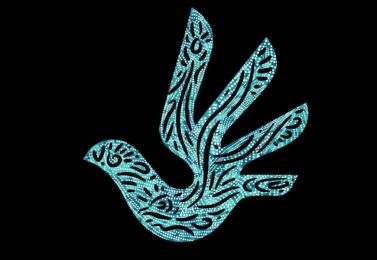
We commissioned a new emblem for the Australian Human Rights Awards to celebrate the 75th anniversary of the Universal Declaration of Human Rights in 2023,
The emblem is an artwork titled Djilba which has been created by First Nations artist Kambarni.
Reflecting the United Nations logo for human rights – which combines the shapes of a hand (representing humanity) and a bird ( representing peace) – the new emblem reinterprets this logo with a uniquely Australian and First Nations sensibility.
Kambarni is a prolific artist, designer, and illustrator, who reflects the natural world with intricate and graphic interpretations of Australian histories:
“This artwork considers the interplay between people and their environment, acknowledging that we are all part of something greater than ourselves - nature and humans are cyclic and connected - and what we put out into this world, we get back.”
Djilba means ‘first spring’ for the Noongar people of the Perth region in Western Australia.
The Commission established the Awards in 1987 to recognise the contributions of individuals across the nation who made it their life’s mission to champion human rights, social justice, and equality for all.
The Awards have evolved over 3 decades to align with Australia’s ever-changing human rights landscape. Originally recognising human rights in film, television and literature, the Award categories now span across a broader field.
The Human Rights Medal has been a constant. Recipients include:
Rose Colless OAM
Fred Hollows
Peter Greste
Dorothy Hoddinott AO
Ian Thorpe
Jonathan Thurston
The Hon Peter McClellan AM QC and Chrissie Foster AM
Rosemary Kayess
Professor Larissa Behrendt AO.
For more information about nominating or attending the Awards, please contact us:
The 2025 Awards attracted more than 300 nominations, with 20 finalists representing a diverse range of contributions - from youth support workers and filmmakers to justice advocates and medical professionals.
This site uses cookies to analyse traffic, remember your preferences, and optimise your experience. We use some essential cookies to make this service work. We’d also like to use analytics cookies so we can understand how you use the service and make improvements. For more information see our Privacy Policy.
Need help?
Have a question about discrimination or sexual harassment? Want to know more about human rights? Contact us if you need help.