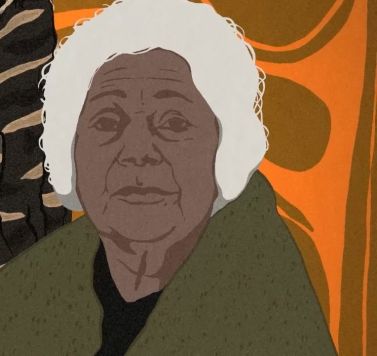
Genevieve Grieves is a proud Worimi woman, award-winning filmmaker, educator, and Co-Creator of GARUWA. A leader in First Nations storytelling, she creates works grounded in Indigenous knowledges that support systemic change. Her acclaimed projects include “Lani’s Story” (SBS), “Power to Country” (ABC), and “Motherhood in the Colony” (2025), as well as leading the curatorial content of the First Peoples permanent exhibition at Melbourne Museum. Genevieve also contributes to sector change through initiatives like the annual First Nations Impact Lab (with Doc Society), building bridges across communities and mentoring the next generation of storytellers with a vision for justice, sovereignty, and enduring cultural resilience. Genevieve’s commitment to social change is underpinned by her work as co-founder of enterprise Shifting Ground, and she serves on the boards of the ArtsPay Foundation, Darwin Community Arts, Original Power, and the Koorie Heritage Trust Inc.
This piece was shaped by Genevieve Grieves and brought to the page together with Maya Ghattas.
Introduction
Every day, Aboriginal and Torres Strait Islander people move through spaces that were built to exclude, assimilate or disappear us: classrooms, supermarkets, hospitals, courtrooms. And every day, in those same spaces, we survive, resist, endure, and in doing so, grow stronger in who we are.
This campaign is about these lived experiences of racism, and of the resistance and practices of self-determination that exist alongside it.
But to understand why we made it, we need to start with some context. Racism in Australia is not a matter of individual prejudice or isolated incidents as we’re often conditioned to identify it. It is a structure. And not only is it still being built and maintained, it is deepening in a moment where we must choose between humanity and care on one side, and indifference and complicity on the other.
The context
I am a Worimi woman from the mid north coast of New South Wales, living on Larrakia Country. While I am a visitor here, I have strong connections to family through my brothers (Gurindji/Malngin, Pertame Arrernte) and my daughter (Malak Malak, Kungarakan, Mulan clan [Iwadja] and Torres Strait Islands [Badu Island]). I love living in this place, as it is held with such care, warmth and strength by Larrakia and all of the mobs of this region. But it is under threat from escalating violence that has continued and evolved since the initial, brutal colonisation of this Country.
The killing of Kumanjayi Walker, ongoing deaths in custody, the lowering of the age of criminal responsibility and the long shadow of the Northern Territory (NT) Intervention - which was in truth an occupation of Aboriginal communities - reveal a familiar and persistent pattern. Racism is not incidental to these events but a force that shapes how power is exercised in its most brutal forms, entrenching the interests of those who benefit from the ongoing dispossession of First Nations people. This pattern repeats across the continent of Australia, in Queensland, where the forcible removal of children from their families continues to destroy Indigenous communities, and in Western Australia, where two teenagers have died within 12 months in youth detention.
In the NT, nearly 90% of the adult prison population are Aboriginal. Children as young as ten are detained and almost 100% of young people in detention are Aboriginal. This escalating situation reveals a broader national shift away from governance grounded in the aspirations of rights and care, toward a system organised around control and containment. At the same time, fossil fuel extraction, military testing, defence housing that bulldozes sacred land, welfare experimentation (like the work-for-the-dole program and cashless debit card) and systemic neglect of children and young people converge, all amid climate predictions that Darwin will face from 141-308 days a year over 35°C by 20270. It’s a suffocating image of a state that is increasingly functioning and being understood as a sacrifice zone.
First Nations people, who are used to living in and resisting a mutating colonial regime, will tell you it’s the system functioning exactly as designed, and that the NT is the frontier of a border that is expanding. This is lamented or commonly understood as failures of a progressive nation-state, but those who have watched the border of that regime move understand it’s working precisely as intended.
This is why I want to be clear about what is actually at stake. The NT is not an exception or an anomaly, it’s the frontier of what our collective future can look like, and frontiers expand. What is being done to First Nations people now, under the rationale of control and containment, has a way of becoming what is done to everyone. Our people have always known this, because they have watched the border of that regime move.
For decades, deficit-based narratives about the dysfunctions of, and risks posed by, First Nations people and our culture have upheld a constant “state of exception.” This is a legal condition in which the government exercises its power to create exemptions to norms and even laws under the pretense of an emergency. It means Aboriginal lives are criminalised, pathologised, medicalised, surveilled, and managed through bureaucratic control rather than priorities of care or consent that centre our self-determination. These are measures so flagrant in their infringement of basic human rights that they would provoke outrage elsewhere, or when enacted upon non-Indigenous peoples.
Over that same period, coverage of Aboriginal and Torres Strait Islander communities has been saturated with deficit framing: stories of crisis, danger, dependency and dysfunction that have little to do with lived reality and everything to do with the reproduction of colonial power. This is not incidental. We need to move past the idea that the media reflects public opinion – it’s –clearer than ever before that it shapes it, normalising the idea that punitive, controlling interventions into Aboriginal lives are reasonable, even necessary and pragmatic, and especially detrimentally, inevitable.
Framed as an extraordinary measure to protect children from sexual abuse in remote Aboriginal communities, the 2007 Intervention imposed sweeping controls over Aboriginal communities in the NT, tellingly – in the context of talking about race – enabled by the suspension of the Racial Discrimination Act and NT anti-discrimination laws. With the complicity of the media, which similarly propagated the racist and divisive "War on Terror" or the "Stop the Boats" campaigns, the intervention normalised a logic of permanent emergency and a governance system that defined, classified and controlled Aboriginal people by race, prioritising punishment, assimilation, compliance and control. This is a logic that persists today and has outlasted its headlines, and we remain in the shadow of the event, unable to clearly see the future it shaped and is shaping, or to act effectively in the present to change it. And yet this colonial logic has never extinguished what it sought to eliminate.
While our responsibility as custodians of these lands, waters and living systems has never stopped being practiced, we are living in a colony that has limited our capacity to actively protect Country from ever multiplying harms.
This is why the possibilities and responsibilities of justice and collective care are not First Nations peoples’ alone to bear, they extend to all people in this place. The threats converging on First Nations communities - rising temperatures, dispossession, surveillance and containment, the dismantling of rights - are not separate crises. These are the same crisis, arriving first at the frontier of the colony and spreading, which is why our rights and protections are only meaningful and material when they are applied to all, and why we need to work collectively and across our differences, in recognition that we are fighting for the same world.
The campaign
It is from within this context that these films emerge. They are intimate accounts of experiences of racism, moments in which harm has been felt and carried.
I started this collaboration with the Race Discrimination Team of the Australian Human Rights Commission around the tipping point of the Voice Referendum. Originally conceived as a documentary project that educated on the importance of developing a literacy on race, so we can move, particularly as First Nations people, beyond identifying interpersonal racism and towards structural understandings that guide us towards systemic reform.
However we responded to some early consultation that identified the very real risk of blowback, namely racism, targeting Storytellers who put their names and faces to their stories. As documentary filmmakers, we are always asking Storytellers to share deeply personal, familial and community experiences of extreme violence. In this moment, the always present obligation to ensure that the process was mutually beneficial and empowering became an even stronger priority. I knew GARUWA needed to creatively treat the stories that emerged to avoid exposure to risk, and over time, it became clear that creating a visual language through art and animation would give us the most freedom to convey the feeling of systemic oppression that might resonate with audiences.
The stories at the heart of this campaign emerged from a Racial Literacy workshop hosted by Dr Lilly Brown (Gumbaynggirr) (who I co-founded Shifting Ground with), and guided by the ideas and teachings of Dianne Jones (Ballardong) and Dr Odette Kelada. Together, we explored racism not only as it’s most commonly encountered or identifiable - in interpersonal moments - but as something built into structures and systems, and started to develop a shared language to name and navigate it.
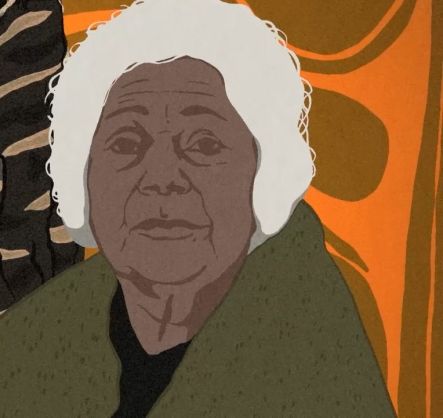
From that foundation, each Storyteller sat with myself or Libby Collins (Tiwi) for a deep-dive conversation, sharing their story in their own words, before artist Yabini Kickett (Noongar/Bibulmun) brought each character to life visually.
The stories you’ll watch represent the true and lived realities of differently abled, queer, straight, young and old First Nations people, surfaced in this dialogue and in follow-up conversations. It was in the process of remembering, listening, shaping and reflecting on these stories collectively that a racial literacy took root amongst our cohort, an understanding of how our individual experiences are entangled with structures of power, and why attending to that entanglement matters.
I’m afraid that as we’ve developed this project, and in the period of time since the Referendum, we’ve witnessed a sharp decline in the social and political conditions for First Nations people, and, as a consequence, all Australians.
The aftermath of extreme local and global events reveals how quickly misinformation spreads. A population already primed to see some lives as less human can be mobilised toward political ends that concentrate wealth and power in the hands of corporations or billionaires. The consequences are profoundly dangerous and divisive. At the same time, we’re being asked to imagine a future shaped by climate change, genocidal land theft, political instability, economic pressures, and profound shifts in how we live together. Every serious conversation about that future emphasises adaptation and community, but community doesn't form organically under pressure, it has to be actively built.
From my conversations with climate advocates, remote community leaders, educators, and activists, I’ve learned that resilience – the condition that emerges when adaptation and community converge – isn’t possible without racial literacy.
How can we respond in ways that strengthen and connect us through our shared humanity, while some communities are still framed as problems to be managed or lives deemed less worthy?
The tactics of division and control make all of us more vulnerable to social, political and environmental shocks. Racial literacy gives us the language to name power, and when practised seriously, it can reveal when crisis narratives and misinformation are weaponised to alienate us from each other. It can serve as a tool for solidarity, enabling alliances across communities and strengthening networks of care and collective action. There isn’t only one solution, especially as we stare down the very troubling applications of generative AI that compromise our shared reality, eroding trust in the image as witness, fabricating voices and histories, flooding our information ecosystems with synthetic noise, and concentrating the power to shape what we see and believe in fewer and fewer hands. But I’m convinced that developing a literacy of race is a meaningful one, because it empowers us to connect the dots between struggles that are too often kept separate and to find each other across differences so we can act from a place of shared stakes.
I want people to watch these films, connect with the fragility and strength of our storytellers, and through this emotional response, recognise that we’re all so vulnerable. Our capacity to imagine a future at all, let alone worth living in, depends on our willingness to reckon honestly with race, which is another way of talking about power and responsibility, and to do so collectively. This always begins by starting exactly where we are, with ourselves, and with those around us.