RightsEd: Disability Rights: Inclusion and Sport
Explore disability rights, inclusion and sports participation for the 4 million Australians living with disability and their families, friends and colleagues.
Summary
Introduction
Almost 4 million Australians live with disabilities. If we add families, friends and colleagues, the number of people affected by disability is larger still.
Introduction
Almost 4 million Australians live with disabilities. If we add families, friends and colleagues, the number of people affected by disability is larger still.
These lessons fit within the Years 7-8 Health and Physical Education curriculum . They are based on the Australian Human Rights Commission's 20 Years: 20 Stories film project , which celebrates 20 years of Australia's Disability Discrimination Act 1992 . The Act provides protection from discrimination for people with disabilities.
These lessons address outcomes in the Health and Physical Education Curriculum across the personal, social and community health strand, and the movement and physical activity strand. They explore themes of health benefits of physical activity, mental health and wellbeing, relationships, and games and sports.
Focus
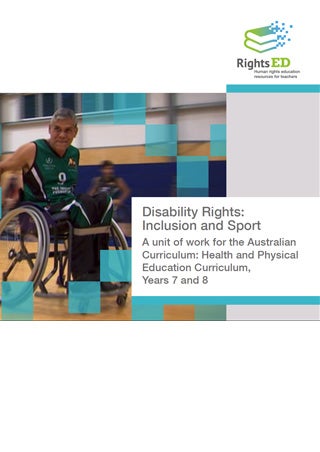
It's a sport only for the ‘fast and furious', but those two words haven't meant much to Paul Gooda until recently. Since taking up wheelchair basketball, the former self-confessed book-worm hasn't looked back. This unit provides opportunities for students to explore the importance of team sports and physical activity for people with disabilities and issues around transitions and trauma, and coping with changes.
Students will explore the following inquiry questions:
- What are the benefits to individuals and communities of valuing diversity?
- What are the physical and mental health benefits, and social benefits of physical activity?
- How can young people who are experiencing transitions or trauma be supported?
- How can diversity and difference be respected through sport?
Image caption: Paul Gooda, Rockwheelers, 20 Years: 20 Stories Film Project , Australian Human Rights Commission.
Teaching and Learning Activities
These lessons can be taught as a unit or as individual lessons:
- Introduction to disability rights
- Inclusive sports (Modified, adapted and disability sports)
- Rockwheelers video: participation in sport
- Playing an inclusive sport
- Challenging stereotypes in sport
Learning outcomes
As a result of this unit students will:
- Analyse the concept of disability rights and how to make sport inclusive.
- Explore the social and emotional benefits of participating in physical activity.
- Experience playing an inclusive sport, and practice modifying rules and removing barriers to make a sport more inclusive.
- Analyse stereotypes and prejudices against athletes with disabilities.
- Identify coping strategies to manage difficult situations that involve young people dealing with transitions or trauma.
Image caption: Paul Gooda, Rockwheelers, 20 Years: 20 Stories Film Project , Australian Human Rights Commission.
Australian Curriculum Links – Health and Physical Education
| Content Description | Elaboration |
|---|---|
| Strand 1: Personal, Social and Community Health | |
| Sub-strand 2: Communicating and interacting for health and wellbeing | |
| Sub-strand 3: Contributing to healthy and active communities | |
| Strand 2: Movement and Physical Activity Strand | |
| Sub-strand 1 Being Healthy Safe and Active | |
| ACPPS070 Investigate the impact of transition and change on identities | identifying feelings and emotions associated with transitions, and practising self-talk and help-seeking strategies to manage these transitions |
| ACPPS072 Practise and apply strategies to seek help for themselves or others | examining scenarios to highlight how emotions, dispositions and decision making can affect outcomes |
| ACPPS073 Investigate and select strategies to promote health, safety and wellbeing | researching opportunities in the local community to participate in regular physical activity and examining how accessible these opportunities are for students |
| ACPPS075 Analyse factors that influence emotions, and develop strategies to demonstrate empathy and sensitivity | investigating personal, social and cultural factors that influence the way individuals respond emotionally to different situations |
| ACPPS079 Examine the benefits to individuals and communities of valuing diversity and promoting inclusivity | examining values and beliefs about cultural and social issues such as disability, gender, race, sexuality and violence.investigating how respecting diversity and challenging disability discrimination, racism, sexism and homophobia influence individual and community health and wellbeing |
| Sub-strand 1: Moving our body | |
| ACPMP080 Use feedback to improve body control and coordination when performing specialised movement skills | participating in activities without vision to demonstrate the importance of auditory feedback |
| Sub-strand 3: Learning through movement | |
| ACPMP088 Modify rules and scoring systems through changes to rules and scoring systems to allow for fair play, safety and inclusive participation | modifying rules, equipment or scoring systems to allow all participants to enjoy and succeed |
identifying feelings and emotions associated with transitions, and practising self-talk and help-seeking strategies to manage these transitions
examining scenarios to highlight how emotions, dispositions and decision making can affect outcomes
researching opportunities in the local community to participate in regular physical activity and examining how accessible these opportunities are for students
investigating personal, social and cultural factors that influence the way individuals respond emotionally to different situations
examining values and beliefs about cultural and social issues such as disability, gender, race, sexuality and violence.
investigating how respecting diversity and challenging disability discrimination, racism, sexism and homophobia influence individual and community health and wellbeing
participating in activities without vision to demonstrate the importance of auditory feedback
modifying rules, equipment or scoring systems to allow all participants to enjoy and succeed
General Capabilities
Literacy The general capabilities emphasised in this unit of work are Ethical Understanding Personal and Social Capability Literacy Information and Communication Technology (ICT) Capability .