'Help way earlier!' How Australia can transform child justice to improve safety and wellbeing
Read evidence-based recommendations to transform Australia's child justice system and improve safety and wellbeing outcomes for young people

Summary
How Australia can transform child justice to improve safety and wellbeing
'Help way earlier!' How Australia can transform child justice to improve safety and wellbeing
- PDF download 22.5 MB
About the report
Our report 'Help way earlier!’ How Australia can transform child justice to improve safety and wellbeing, looks at the rights of children at risk of or in contact with the justice system.
It recommends evidence-based, national reforms to:
- protect the human rights of children
- reduce child offending
- keep communities safe.
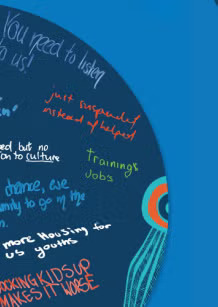
It centres the voices of children and their families, and their views on how to improve child wellbeing and prevent children's contact with the justice system.

Tragically, by not addressing their human rights early on, and instead taking a punitive approach to their offending, we are essentially criminalising some of the most vulnerable children in Australia.
All documents
'Help way earlier!' How Australia can transform child justice to improve safety and wellbeing
Full report
'Help way earlier!' How Australia can transform child justice to improve safety and wellbeing
Executive summary
About the report 'Help way earlier!'
Easy read version
Recommendations to make the justice system better
Easy read version
Child-friendly video by former National Children's Commissioner
About the report
The treatment of children in the criminal justice system, some as young as 10 years old, is one of the most urgent human rights issues facing Australia today. Many reviews and investigations over the years have shown serious problems and repeated failures in our child justice systems.
Vulnerable children and their families told us they need “help way earlier.”
Key findings of the report:
- Many children in contact with child justice systems have experiences of poverty, violence and abuse, intergenerational trauma, mental health issues, homelessness, drug and alcohol abuse and neurodevelopmental disabilities.
- Many are in the child protection systems or living in out-of-home care.
- If children at risk are supported earlier on - whether in the community, in detention, or when released from detention – they are less likely to be involved in criminal activity, keeping them and our communities safe.
Report methodology
The report is based on submissions, interviews and consultations involving hundreds of stakeholders across Australia.
We spoke with 150 children and young people who are, have been or are at risk of contact with the child justice system.
Other contributors were:
- family and community members
- youth justice departments
- police
- judicial officers
- First Nations organisations
- state and territory children’s commissioners and guardians
- academics
- relevant NGOs.
Statistics from the report
- On an average day, 4542 children across Australia were under youth justice supervision.
- 80% in detention were unsentenced.
- 57% were Aboriginal and Torres Strait Islander children
- Indigenous children were 23 times more likely to be under supervision and 28 times more likely to be in detention than non-Indigenous children
- About 85% of children released from supervised detention return to sentenced supervision within 12 months.
- Children from the lowest socio-economic areas are 7 times more likely to be under supervision than children from the highest socio-economic areas.
Recommendations for reform
The Australian government should:
- establish a national taskforce for reform of child justice systems
- appoint a Cabinet Minister for Children
- legislate a National Children’s Act incorporating the Convention on the Rights of the Child and a Human Rights Act
- establish a Ministerial Council for Child Wellbeing
- position children at the centre of policymaking and service delivery
- empower First Nations children, families and communities
- optimise community-based action
- build a capable and child-specialised workforce
- base systems on data and evidence
- embed accountability for the rights of children.
Evidence-based approaches to reforming child justice systems
Evidence-based approaches to child justice
Released in October 2025, this supplement to our landmark 'Help way earlier!' report on child justice reform contains 6 case studies from Australia and around the world that are examples of evidence-based approaches to reforming child justice systems.
Support services
- Kids Helpline: Call 1800 55 1800, or use their webchat.
- Lifeline: Call 13 11 14, text them on 0477 13 11 14, or chat to them online.
- Headspace: Call 1800 650 890.
More on children's rights:
- Watch the former National Children's Commissioner's press club address on child justice and wellbeing.
- Read Evidence-based approaches to child justice: Supplementary paper to 'Help way earlier!'
- Read ‘Left Alone’: A Review of Solitary Confinement and Similar Practices in Australia’s Youth Justice Systems.
- Read the submissions to 'Help way earlier!'
- Explore our work on Supporting Quality Engagement with Children.
- Understand what children and young people need to support their safety and wellbeing.
- Read the Australian Institute of Family Studies report on improving the safety and wellbeing of children.