Social Justice Report 2006: Recommendations
Access all recommendations from the 2006 Social Justice Report on improving human rights outcomes and policy for Aboriginal and Torres Strait Islander Peoples.
Social Justice Report 2006
Back to ContentsRecommendations and notes
Recommendations
In accordance with the functions set out in section 46C(1) (a) of the Human Rights and Equal Opportunity Commission Act 1986 (Cth), this report includes 8 recommendations – 3 in relation to the accessibility of mainstream services under the new arrangements for Iindigenous affairs, 1 in relation to engaging with Iindigenous communities under the new arrangements for Iindigenous affairs and 4 in relation to international developments on the rights of iindigenous peoples. The report also contains 1 follow up action that my office will undertake in the next 12 months in relation to options for the establishment of the a national Iindigenous representative body. These and the recommendations are reproduced here and appear at the relevant part of the report.
The new arrangements for Iindigenous affairs – facilitating Iindigenous access to government services
Recommendation 1: Directed to Federal Parliament
That there be established a regular federal parliamentary committee of inquiry into the progress of the new arrangements in Iindigenous affairs and progress in achieving whole of government service delivery to Iindigenous communities. This Inquiry should be conducted every two years. Its terms of reference should include identifying:
- Progress in addressing existing inequalities in Iindigenous peoples' access (both urban and remote) to mainstream services (including the adequacy of processes to ensure that Iindigenous specific expenditure supplements mainstream expenditure rather than substitutes for this expenditure);
- Progress in ensuring that processes are targeted so as to address existing need;
- Effective, sustainable and representative mechanisms for the participation of Iindigenous peoples at the local, regional and national levels;
- The adequacy of performance monitoring and evaluation mechanisms for the new arrangements, including the adequacy of data collected to evaluate progress in addressing Iindigenous disadvantage; and
- Whether the new arrangements are meeting the commitments made by the Australian Government through COAG to overcome Iindigenous disadvantage.
The Committee's terms of reference should also require it to report on the extent to which the new arrangements in Iindigenous affairs comply with human rights based approaches to development and engagement with Iindigenous peoples. The Committee's inquiry processes should be required to maximise participation by Iindigenous peoples, including by consulting widely with Iindigenous communities and organisations.
Recommendation 2: Directed to the Council of Australian Governments, National Iindigenous Council and Ministerial Taskforce on Iindigenous Affairs
That there is acknowledgement by government of the importance of a human rights based approach to development in order to effectively implement the new arrangements and the achievement of effective and sustainable improvements in Iindigenous living standards and well-being. This requires acknowledgement of the importance of Iindigenous forms of social organisation on the basis of mutual respect and good faith and for supported processes, including through capacity building initiatives, to ensure that the aspirations of Iindigenous peoples are able to be voiced.
Recommendation 3: Directed to the Office of Iindigenous Policy Coordination
That, in exercise of its coordination and monitoring role at a whole of government level, the Office of Iindigenous Policy Coordination:
- Identify and promote best practice examples of improving accessibility of mainstream services as achieved through individual programs (such as Medicare and Pharmaceutical Benefits Scheme equivalent access arrangements) as well as through whole of government coordination initiatives (such as ICCs and SRAs); and
Develop its proposed Iindigenous urban strategy with the full participation of Iindigenous communities and peoples in urban localities, and with the inclusion of explicit targets and benchmarks for improved access to programs.
Addressing the fundamental flaw of the new arrangements for Iindigenous affairs – the absence of principled engagement with Iindigenous peoples
Recommendation 4: Directed to the Ministerial Taskforce on Iindigenous Affairs and National Iindigenous Council
That the Ministerial Taskforce on Iindigenous Affairs acknowledge that the absence of mechanisms at the regional level for engagement of Iindigenous peoples contradicts and undermines the purposes of the federal whole of government service delivery arrangements. Further, that the Ministerial Taskforce direct the Office of Iindigenous Policy Coordination to address this deficiency as an urgent priority, including by:
- consulting with Iindigenous communities and organisations as to suitable structures, including by considering those proposals submitted to the government for regional structures;
- utilising the Expert Panels and Multiuse List of community facilitators/ coordinators to prioritise consideration of this issue; and
- funding interim mechanisms to coordinate Iindigenous input within regions and with a view to developing culturally appropriate models of engagement.
Further, that the National Iindigenous Council request the OIPC to report quarterly on progress in developing regional engagement arrangements and the mechanisms put into place to facilitate Iindigenous participation in this process.
International developments on the rights of iindigenous peoples – Closing the ‘protection gap'
R ecommendation 5: Directed to the Office of Iindigenous Policy Coordination
That the federal government identify a focal point to coordinate, on a whole of government basis, its Program for the Second Decade of the World's Iindigenous Peoples. The focal point should consult with Iindigenous organisations in determining the activities to be undertaken for the Decade, in accordance with the goal, objectives and Program of Action for the Decade. The Government's Program should specifically respond to the items identified in the Program of Action for the Second Decade, rather than being a general thematic response. The Program should also be operational within this financial year. Further, that the government allocate specific funding for the conduct of activities for the Second Decade, as determined through the consultations with Iindigenous peoples.
Recommendation 6: Directed to the Office of Iindigenous Policy Coordination and Department of Foreign Affairs and Trade
That the federal government specify the process for consideration of funding for engagement in international deliberations and identify focal points within each federal department or agency (for example, the relevant contact point within the Department of the Environment and Heritage for engagement on issues relating to the Convention on Biological Diversity).
Recommendation 7: Directed to the Iindigenous Peoples Organisations Network and Australian Council for International Development
That the non-government sector, led by members of the Australian Council for International Development as appropriate, engage with Iindigenous organisations and the IPO Network to build partnerships for the implementation of the Second International Decade (as well as highlighting the relevance of the Millennium Development Goals to the situation of Iindigenous peoples in Australia).
Recommendation 8: Directed to the Department of Foreign Affairs and Trade, AusAid and Office of Iindigenous Policy Coordination
That the Department of Foreign Affairs, in conjunction with the Social Justice Commissioner, conduct regular briefings for all agency heads on developments on the rights of Iindigenous peoples, including the right to development (including the human rights based approach to development), Millennium Development Goals and Second International Decade for the World's Iindigenous People. The Secretaries Group on Iindigenous Affairs would be the appropriate body to receive these briefings. Further, that AusAid be invited to contribute to the Secretaries Group on Iindigenous Affairs to identify lessons that can be learned from Australia's international development activities for policy-making on Iindigenous issues within Australia.
Follow Up Action by Social Justice Commissioner
The Social Justice Commissioner will work with Iindigenous organisations and communities to identify sustainable options for establishing a national Iindigenous representative body. The Commissioner will conduct research and consultations with non-government organisations domestically and internationally to establish existing models for representative structures that might be able to be adapted to the cultural situation of Iindigenous Australians, as well as methods for expediting the establishment of such a body given the urgent and compelling need for such a representative body.
Acknowledgements
The Aboriginal and Torres Strait Islander Social Justice Commissioner acknowledges the work of Human Rights and Equal Opportunity Commission staff and consultants in producing this report (Shondelle Bolt, Michael Davis, Anna Dawson, Darren Dick, Janet Drummond, Vanessa Jackson, Bettina King, Greg Marks and Emilie Priday).
Artist Acknowledgement
The cover photographs are from the 40 years Freedom Day Festival held on 18 and 19 August 2006 at Kalkaringi and Daguragu. Information about the festival is included on the back cover of this report and further information can be obtained from www.freedomday.info/festival.html .
Our thanks to the Daguragu Community Government Council and the communities of Kalkaringi and Daguragu for the permission to reproduce these images. Our thanks also to Trevor van Weeren for facilitating the copyright permissions and supply of images and text.
About the Social Justice Commission logo
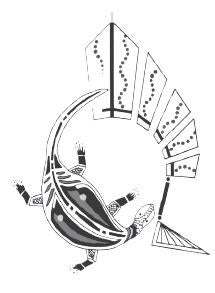
The right section of the design is a contemporary view of traditional Dari or head-dress, a symbol of the Torres Strait Island people and culture. The head-dress suggests the visionary aspect of the Aboriginal and Torres Strait Islander Social Justice Commission. The dots placed in the Dari represent a brighter outlook for the future provided by the Commission's visions, black representing people, green representing islands and blue representing the seas surrounding the islands. The Goanna is a general symbol of the Aboriginal people.
The combination of these two symbols represents the coming together of two distinct cultures through the Aboriginal and Torres Strait Islander Commission and the support, strength and unity which it can provide through the pursuit of Social Justice and Human Rights. It also represents an outlook for the future of Aboriginal and Torres Strait Islander Social Justice expressing the hope and expectation that one day we will be treated with full respect and understanding. © Leigh Harris
Note - Use of the terms ‘Aboriginal and Torres Strait Islander peoples' and ‘Iindigenous peoples'
The Aboriginal and Torres Strait Islander Social Justice Commissioner recognises the diversity of the cultures, languages, kinship structures and ways of life of Aboriginal and Torres Strait Islander peoples. There is not one cultural model that fits all Aboriginal and Torres Strait Islander peoples.
Aboriginal and Torres Strait Islander peoples retain distinct cultural identities whether they live in urban, regional or remote areas of Australia.
Throughout this report, Aborigines and Torres Strait Islanders are referred to as ‘ peoples '. This recognises that Aborigines and Torres Strait Islanders have a collective, rather than purely individual, dimension to their livelihoods. Throughout this report, Aboriginal and Torres Strait Islander peoples are also referred to as ‘ Iindigenous peoples '.
The use of the term ‘Iindigenous' has evolved through international law. It acknowledges a particular relationship of Aboriginal people to the territory from which they originate. The United Nations High Commissioner for Human Rights has explained the basis for recognising this relationship as follows:
Iindigenous or aboriginal peoples are so-called because they were living on their lands before settlers came from elsewhere; they are the descendants - according to one definition - of those who inhabited a country or a geographical region at the time when people of different cultures or ethnic origins arrived, the new arrivals later becoming dominant through conquest, occupation, settlement or other means… (I)indigenous peoples have retained social, cultural, economic and political characteristics which are clearly distinct from those of the other segments of the national populations.
Throughout human history, whenever dominant neighbouring peoples have expanded their territories or settlers from far away have acquired new lands by force, the cultures and livelihoods - even the existence - of iindigenous peoples have been endangered. The threats to iindigenous peoples' cultures and lands, to their status and other legal rights as distinct groups and as citizens, do not always take the same forms as in previous times. Although some groups have been relatively successful, in most part of the world iindigenous peoples are actively seeking recognition of their identities and ways of life. 1
The Social Justice Commissioner acknowledges that there are differing usages of the terms ‘Aboriginal and Torres Strait Islander', ‘Aboriginal' and ‘iindigenous' within government policies and documents. When referring to a government document or policy, we have maintained the government's language to ensure consistency.
[1] United Nations High Commissioner for Human Rights, Fact sheet No.9 (Rev.1), The Rights of Iindigenous Peoples, www.unhchr.ch/html/menu6/2/fs9.htm