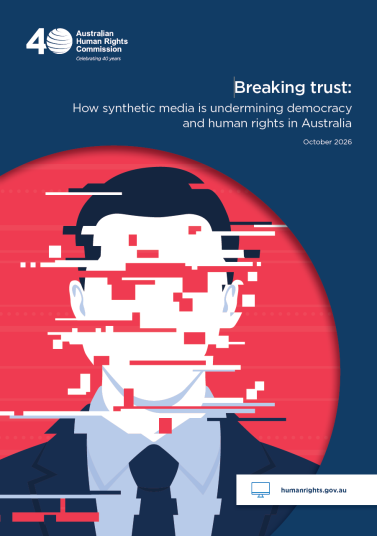
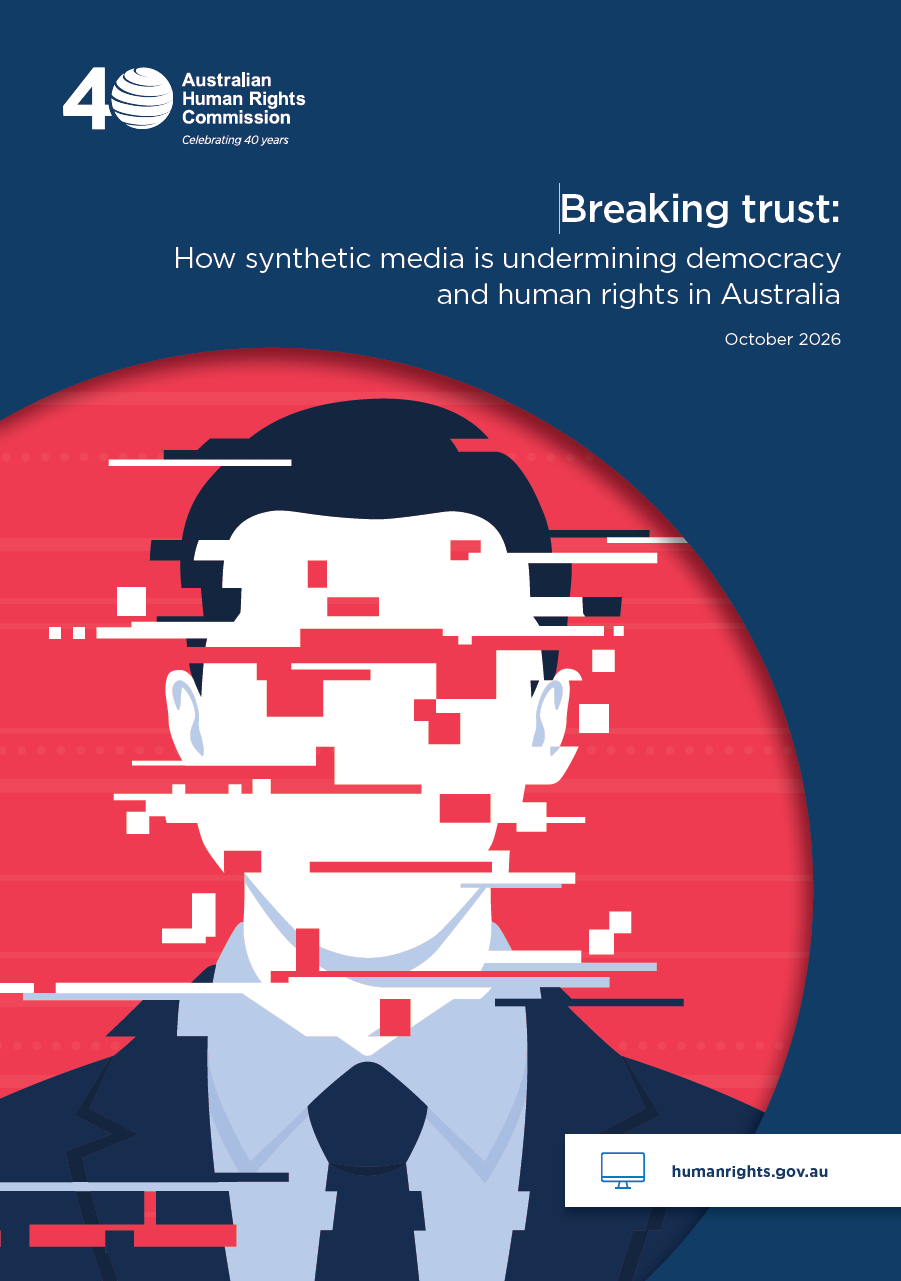
Breaking trust: New report examines deepfakes, democracy and human rights
Explore how deepfakes and other AI-generated media can harm individuals, weaken public trust and undermine democratic participation.
Summary
Deepfakes do not need to fool everyone to cause harm. They can violate privacy, silence people in public debate and create uncertainty about what information can be trusted.
This report from the Australian Human Rights Commission finds that Australian democracy is currently unprepared for the risks posed by synthetic media. It calls for a coordinated, layered response that combines legal protections, technical safeguards, education, independent media and trusted public institutions.
Breaking trust: New report examines deepfakes, democracy and human rights
- PDF download 6.3 MB
Overview
This report examines how AI-generated or altered images, video and audio are changing the conditions in which people exercise their rights and participate in public life.
Deepfakes can falsely depict a real person saying or doing something they never said or did. They are one form of synthetic media, a broader term that also includes AI-generated depictions of fabricated events, places or groups.
The report explores two connected harms: the direct harm experienced by people whose image, voice or identity is misused, and the wider damage caused when people become less certain about what is real. These effects can endure even after content is identified as false or removed.
The challenge is not simply to help people spot a fake. It is to protect people’s ability to speak, access reliable information and participate in public life with confidence, while safeguarding freedom of expression and legitimate political debate.
Background
The report draws on research and expert consultation conducted during 2026, including engagement with academics, civil society, legal bodies, government agencies and major social media platforms.
It examines Australian legal protections alongside technical and civic responses, considering both what these measures can achieve and where they fall short.
Rather than focusing only on individual incidents, the report considers how synthetic media can have cumulative effects on human rights, public trust and democratic resilience.
Key findings and recommendations
- The harms go beyond deception. Synthetic media can damage reputations, facilitate harassment and discourage participation in public life. It can also enable genuine evidence to be dismissed as fake, weakening accountability even when fabricated content is not widely believed.
- The impacts are unequal. Women and marginalised communities often experience disproportionate targeting. Deepfake sexual abuse and discriminatory content can increase the personal cost of speaking publicly, narrowing whose voices are heard.
- Harm can spread faster than an effective response. Synthetic media enables manipulation at low cost and significant scale. Corrections and removal may come too late to prevent lasting damage to individuals and public trust.
- Existing protections are important but limited. Australia’s laws provide avenues for intervention and redress, but many depend on individuals identifying harmful content and pursuing processes that may be slow, costly or difficult to enforce.
- Safeguards must protect democratic freedoms. Responses must preserve freedom of expression, including legitimate satire and political commentary, and protect the independence and neutrality of public institutions.
- Australia is not prepared. A sustained, coordinated response is needed across legal, technical and civic domains. No single law, technology or institution can address these risks alone.
A layered response: Prevent, respond and remedy
The report sets out three reinforcing functions for Australia’s response: prevent harm where possible, respond effectively when harmful content circulates, and provide remedies and accountability after harm occurs.
This requires complementary measures, including:
- Targeted legal protections that address harmful conduct and provide accessible remedies, with clear safeguards for legitimate expression.
- Technical transparency, including consistent labels, embedded information about how content was created, and authenticity measures, without treating these tools as conclusive proof of what is real.
- Digital, media and civics education that helps people assess information and participate confidently in democratic life.
- Independent journalism and responsible content creators that verify information, explain uncertainty and challenge deceptive content.
- Trusted public institutions with the independence, resources and capacity to provide reliable information.
Responsibility must be shared across governments, technology companies, media organisations, educators and civil society. These measures should reinforce one another, rather than leave individuals to manage the risks alone.
Download the report and the background paper
Download the report
The report explores how deepfakes and other AI-generated media can harm individuals, weaken public trust and undermine democratic participation.
