Statistics about disability rights
Explore statistics on people with disability in Australia, including data on employment, health, education, and experiences of discrimination.

Introduction
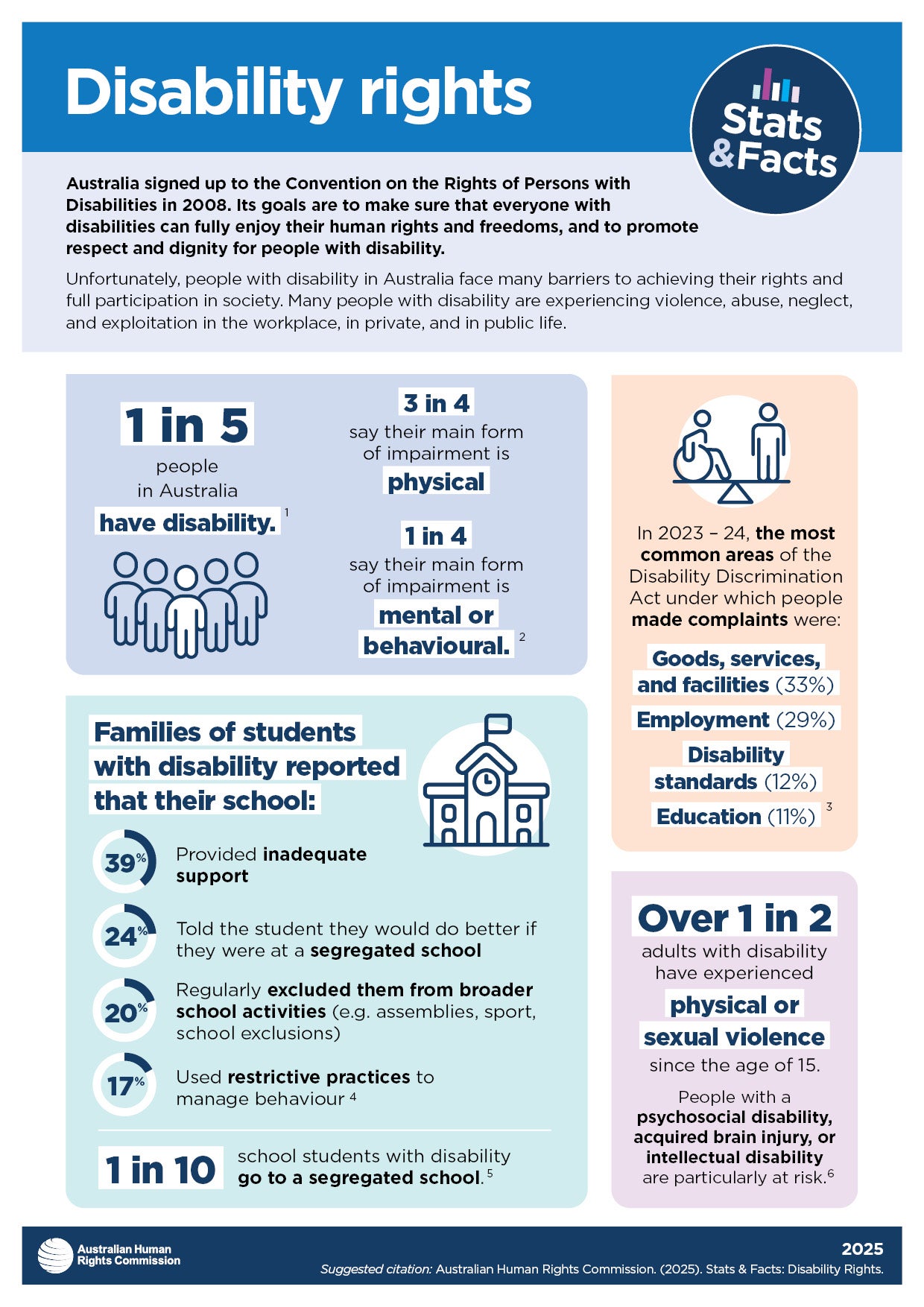
Australia signed up to the Convention on the Rights of Persons with Disabilities in 2008. Its goals are to make sure that everyone with disabilities can fully enjoy their human rights and freedoms, and to promote respect and dignity for people with disability.
Unfortunately, people with disability in Australia face many barriers to achieving their rights and full participation in society. Many people with disability are experiencing violence, abuse, neglect, and exploitation in the workplace, in private, and in public life.
19/08/2025
Demographics
- 1 in 5 people in Australia have disability.[1]
- About 3 in 4 people in Australia who have a disability say their main form of impairment is physical, while about 1 in 4 say their main form of impairment is mental or behavioural.[2]
Complaints to the Commission
- In 2023 – 24, the most common areas of the Disability Discrimination Act under which people made complaints were:
- goods, services, and facilities (33%)
- employment (29%)
- disability standards (12%)
- education (11%).[3]
Education
- Families of students with disability reported that their school:
- provided inadequate support (39%)
- told the student they would do better if they were at a segregated school (24%)
- regularly excluded them from broader school activities (e.g. assemblies, sport, school exclusions) (20%)
- used restrictive practices to manage behaviour (17%)[4]
- 1 in 10 students with disability go to a segregated school.[5]
Experiences of violence
- More than half of all people with disability aged 18 to 64 have experienced physical or sexual violence since the age of 15. People with a psychosocial disability, acquired brain injury, or intellectual disability are particularly at risk.[6]
Employment and NDIS eligibility
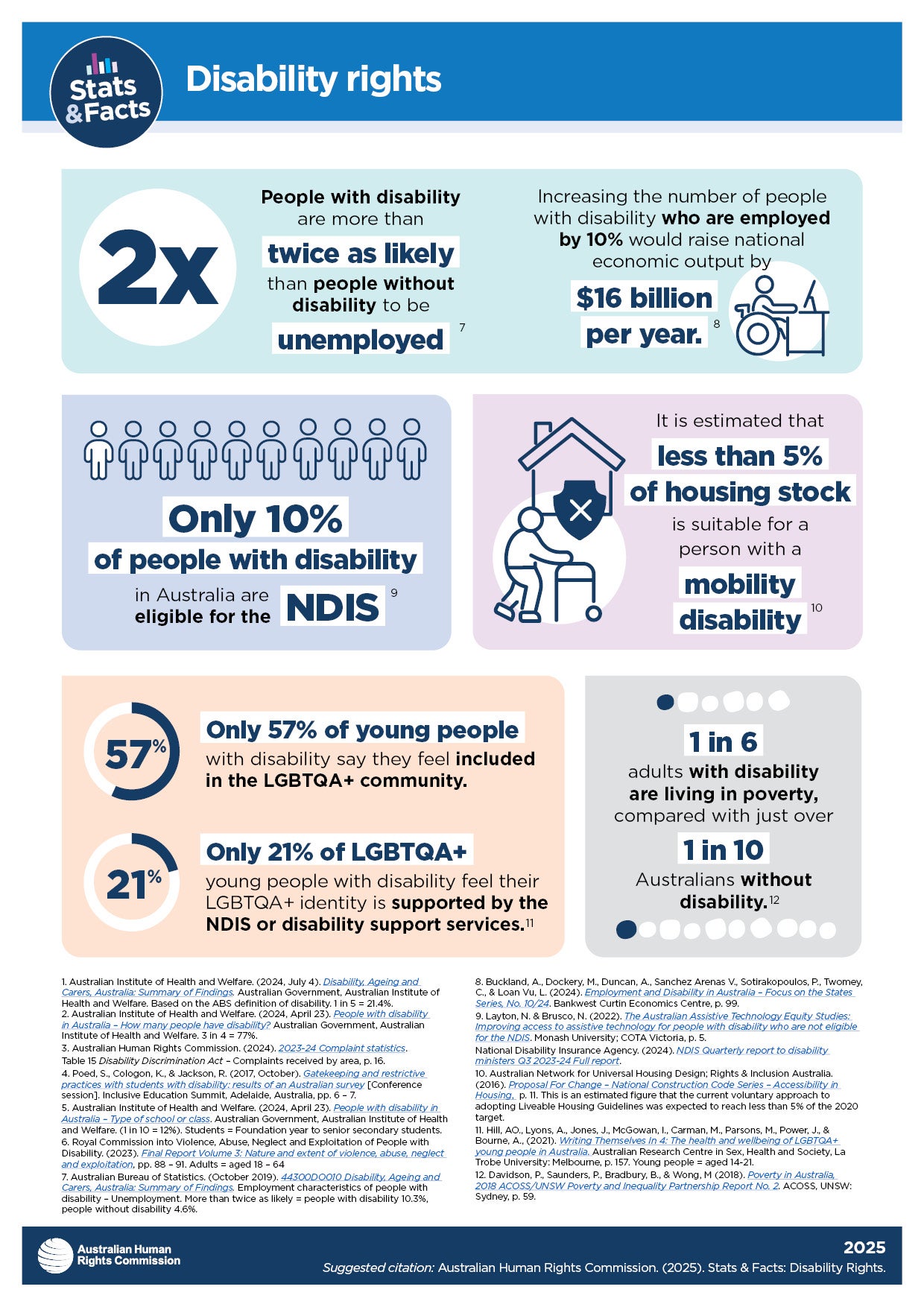
- People with disability are more than 2 times as likely than people without disability to be unemployed.[7]
- Increasing the number of people with disability who are employed by 10% would raise national economic output by $16 billion per year.[8]
- Only 10% of people with disability in Australia are eligible for the NDIS.[9]
LGBTQA+ people with disability
- Only 57% of LGBTQA+ young people with disability say they feel included in the LGBTQA+ community.[10]
- Only 21% LGBTQA+ young people with disability feel their LGBTQA+ identity is supported by the NDIS or disability support services.[11]
Housing and poverty
- It is estimated that less than 5% of housing stock is suitable for a person with a mobility disability.[12]
- 1 in 6 adults with disability are living in poverty, compared with just over 1 in 10 Australians without disability.[13]
Suggested citation
Suggested citation: Australian Human Rights Commission (2025) Stats & Facts: Disability Rights.
Downloads
Suggested citation
Australian Human Rights Commission. (2025). Stats & Facts: Disability rights.
References
[1] Australian Institute of Health and Welfare. (2024, July 4). Disability, Ageing and Carers, Australia: Summary of Findings. Australian Government, Australian Institute of Health and Welfare. Based on the ABS definition of disability. 1 in 5 = 21.4%.
[2] Australian Institute of Health and Welfare. (2024, April 23). People with disability in Australia – How many people have disability? Australian Government, Australian Institute of Health and Welfare. 3 in 4 = 77%.
[3] Australian Human Rights Commission. (2024). 2023-24 Complaint statistics. Table 15 Disability Discrimination Act – Complaints received by area, p. 16.
[4] Poed, S., Cologon, K., & Jackson, R. (2017, October). Gatekeeping and restrictive practices with students with disability: results of an Australian survey [Conference session]. Inclusive Education Summit, Adelaide, Australia, pp. 6 – 7.
[5] Australian Institute of Health and Welfare. (2024, April 23). People with disability in Australia – Type of school or class. Australian Government, Australian Institute of Health and Welfare. 1 in 10 = 12%. Students = Foundation year to senior secondary students.
[6] Royal Commission into Violence, Abuse, Neglect and Exploitation of People with Disability. (2023). Final Report Volume 3: Nature and extent of violence, abuse, neglect and exploitation, pp. 88 – 91.
[7] Australian Bureau of Statistics. (October 2019). 44300DO010Disability, Ageing and Carers, Australia: Summary of Findings. Employment characteristics of people with disability – Unemployment. More than twice as likely = people with disability: 10.3%. People without disability: 4.6%.
[8] Buckland, A., Dockery, M., Duncan, A., Sanchez Arenas V., Sotirakopoulos, P., Twomey, C., & Loan Vu, L. (2024). Employment and Disability in Australia – Focus on the States Series, No. 10/24. Bankwest Curtin Economics Centre, p. 99.
[9] Layton, N. & Brusco, N. (2022). The Australian Assistive Technology Equity Studies: Improving access to assistive technology for people with disability who are not eligible for the NDIS. Monash University; COTA Victoria, p.5. National Disability Insurance Agency. (2024). NDIS Quarterly report to disability ministers Q3 2023-24 Full report.
[10] Hill, AO., Lyons, A., Jones, J., McGowan, I., Carman, M., Parsons, M., Power, J., & Bourne, A., (2021). Writing Themselves In 4: The health and wellbeing of LGBTQA+ young people in Australia. Australian Research Centre in Sex, Health and Society, La Trobe University: Melbourne, p. 157. Young people = aged 14 – 21.
[11] Hill, AO., Lyons, A., Jones, J., McGowan, I., Carman, M., Parsons, M., Power, J., & Bourne, A., (2021). Writing Themselves In 4: The health and wellbeing of LGBTQA+ young people in Australia. Australian Research Centre in Sex, Health and Society, La Trobe University: Melbourne, p. 157. Young people = aged 14 – 21.
[12] Australian Network for Universal Housing Design; Rights & Inclusion Australia. (2016). Proposal For Change – National Construction Code Series – Accessibility in Housing, p. 11. This is an estimated figure that the current voluntary approach to adopting Liveable Housing Guidelines was expected to reach less than 5% of the 2020 target.
[13] Davidson, P., Saunders, P., Bradbury, B., & Wong, M (2018). Poverty in Australia, 2018 ACOSS/UNSW Poverty and Inequality Partnership Report No. 2. ACOSS, UNSW: Sydney. p. 59.


