Statistics about technology and human rights
Understand how digital technologies affect human rights, including privacy, freedom of expression, and non-discrimination through data and evidence.
Introduction
Access to technology is essential to modern living. While technology brings many advantages, it can also create serious problems for many people from marginalised and vulnerable groups.
19/08/2025
The ‘digital divide' between people who can and can't access technology makes existing inequalities even worse.
Technology must be developed and used with human rights at its core to avoid increasing inequality in our society.
Misinformation
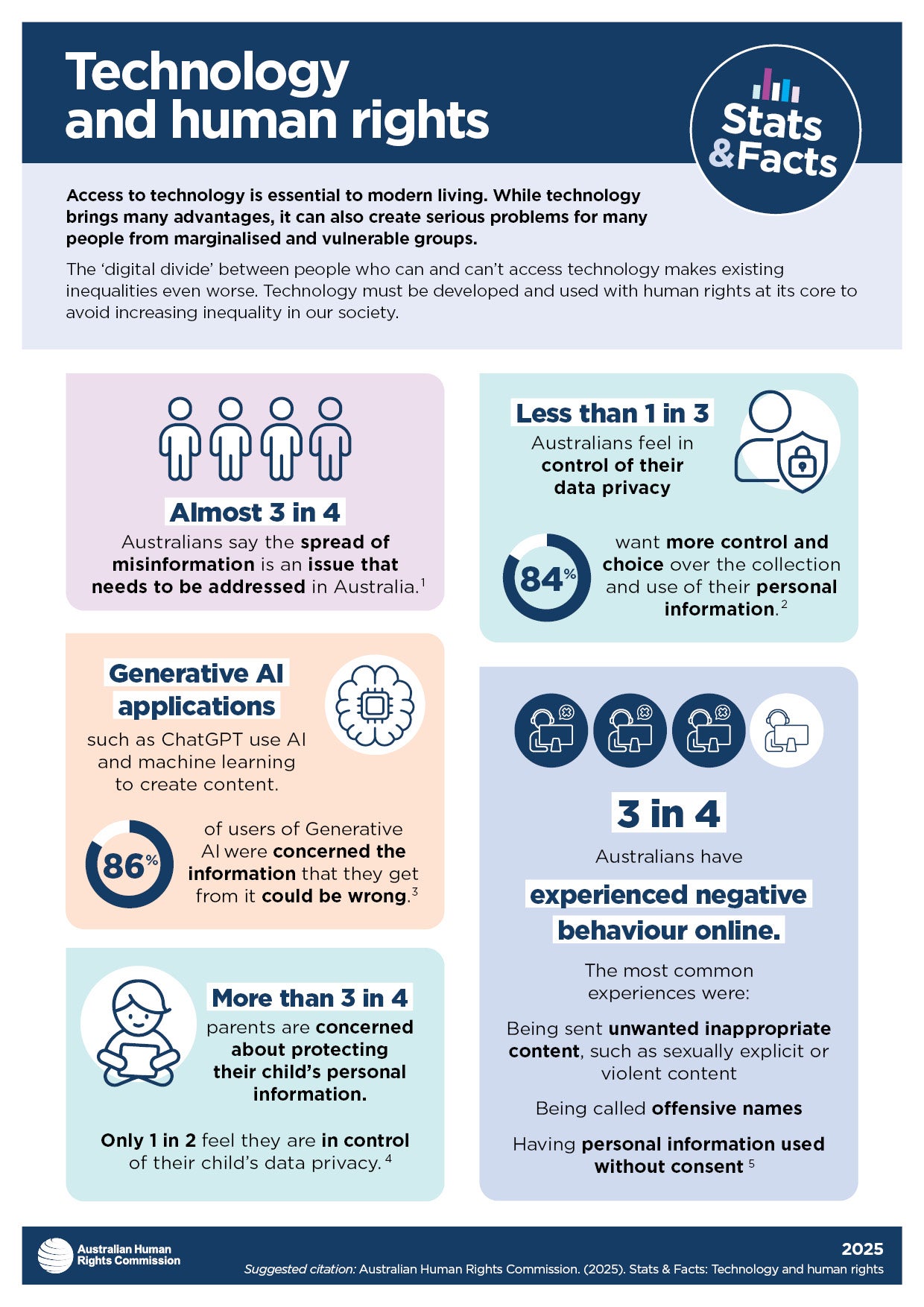
- Almost 3 in 4 Australians say the spread of misinformation is an issue that needs to be addressed in Australia.[1]
- Generative AI applications, such as ChatGPT, use AI and machine learning to create content. 86% of users of Generative AI were concerned the information that they get from it could be wrong.[2]
Privacy
- Less than 1 in 3 Australians feel in control of their data privacy and 84% want more control and choice over the collection and use of their personal information.[3]
- More than 3 in 4 parents are concerned about protecting their child's personal information. However, only 1 in 2 feel they are in control of their child's data privacy.[4]
Negative online experiences
- 3 in 4 Australians have experienced negative behaviour online. The most common experiences were:
- being sent unwanted inappropriate content, such as sexually explicit or violent content
- being called offensive names
- having personal information used without consent[5]
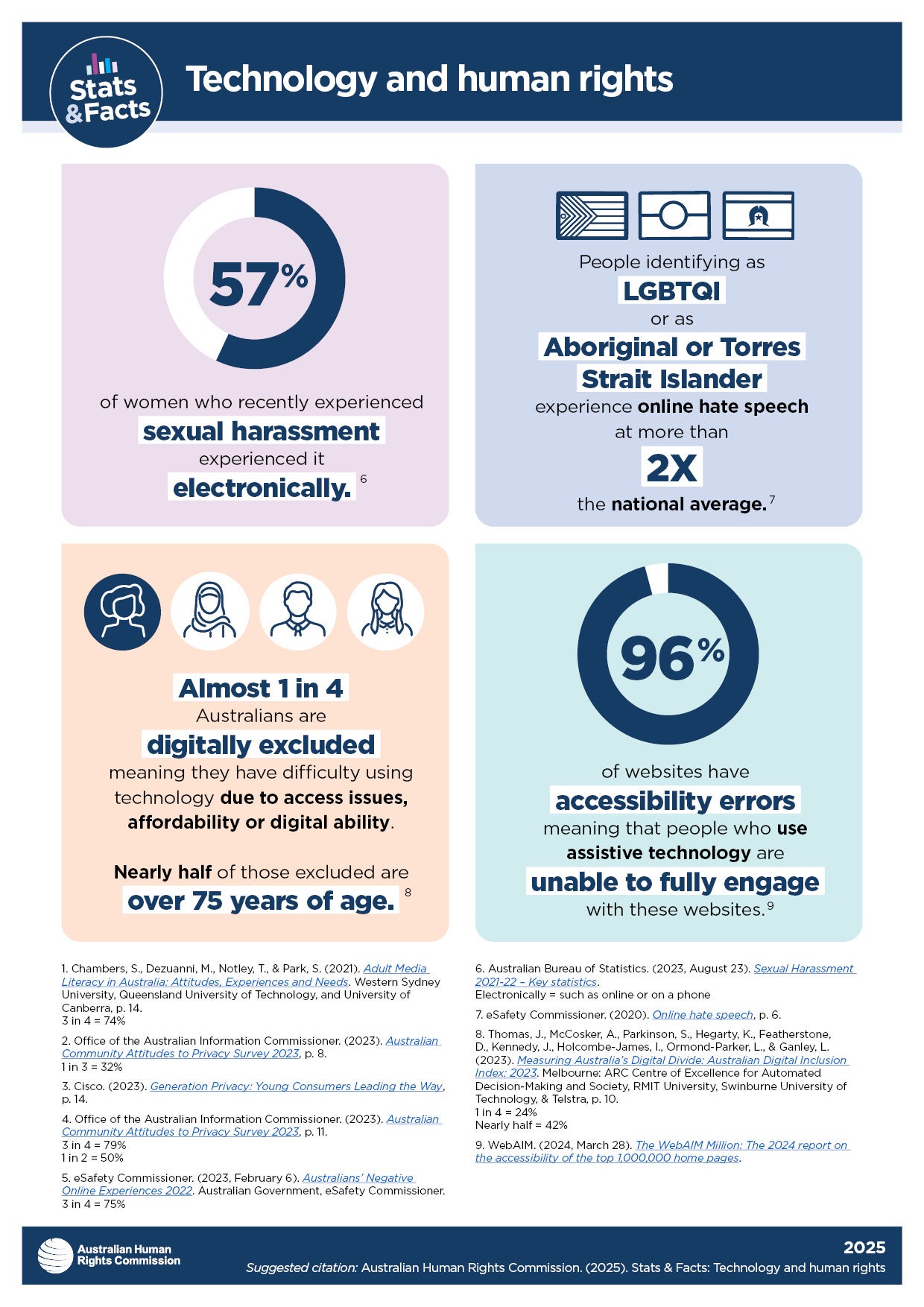
- People identifying as LGBTIQA+ or as Aboriginal or Torres Strait Islander experience online hate speech at more than 2 times the national average.[6]
- 57% of women who recently experienced sexual harassment experienced it electronically.[7]
Digital exclusion
- Almost 1 in 4 Australians are digitally excluded, meaning they have difficulty using technology due to access issues, affordability or digital ability.[8]
- Nearly half of those excluded are over 75 years of age.[9]
- 96% of websites have accessibility errors, meaning that people who use assistive technology are unable to fully engage with these websites.[10]
Downloads
Suggested citation
Suggested citation: Australian Human Rights Commission. (2025). Stats & Facts: Technology and Human Rights.
References
[1] Chambers, S., Dezuanni, M., Notley, T., & Park, S. (2021). Adult Media Literacy in Australia: Attitudes, Experiences and Needs. Western Sydney University, Queensland University of Technology, and University of Canberra. p. 14. 3 in 4 = 74%.
[2] Cisco. (2023). Generation Privacy: Young Consumers Leading the Way, p. 14.
[3] Office of the Australian Information Commissioner. (2023). Australian Community Attitudes to Privacy Survey 2023. p. 8. 1 in 3 = 32%.
[4] Office of the Australian Information Commissioner. (2023). Australian Community Attitudes to Privacy Survey 2023. p. 11. 3 in 4 = 79%. 1 in 2 = 50%.
[5] eSafety Commissioner. (2023, February 6). Australians' Negative Online Experiences 2022. Australian Government, eSafety Commissioner. 3 in 4 = 75%.
[6] eSafety Commissioner. (2020). Online hate speech. p. 6.
[7] Australian Bureau of Statistics. (2023, August 23). Sexual Harassment 2021-22 – Key statistics. Electronically = such as online or on a phone.
[8] Thomas, J., McCosker, A., Parkinson, S., Hegarty, K., Featherstone, D., Kennedy, J., Holcombe-James, I., Ormond-Parker, L., & Ganley, L. (2023). Measuring Australia's Digital Divide: Australian Digital Inclusion Index: 2023. Melbourne: ARC Centre of Excellence for Automated Decision-Making and Society, RMIT University, Swinburne University of Technology, & Telstra. p. 10. 1 in 4 = 24%.
[9] Thomas, J., McCosker, A., Parkinson, S., Hegarty, K., Featherstone, D., Kennedy, J., Holcombe-James, I., Ormond-Parker, L., & Ganley, L. (2023). Measuring Australia's Digital Divide: Australian Digital Inclusion Index: 2023. Melbourne: ARC Centre of Excellence for Automated Decision-Making and Society, RMIT University, Swinburne University of Technology, & Telstra. p. 10. Nearly half = 42%
[10] WebAIM. (2024, March 28). The WebAIM Million: The 2024 report on the accessibility of the top 1,000,000 home pages.