The Speaking from Experience report
Read Speaking from Experience, a landmark report calling for stronger measures to combat sexual harassment in Australian workplaces and institutions.

Summary
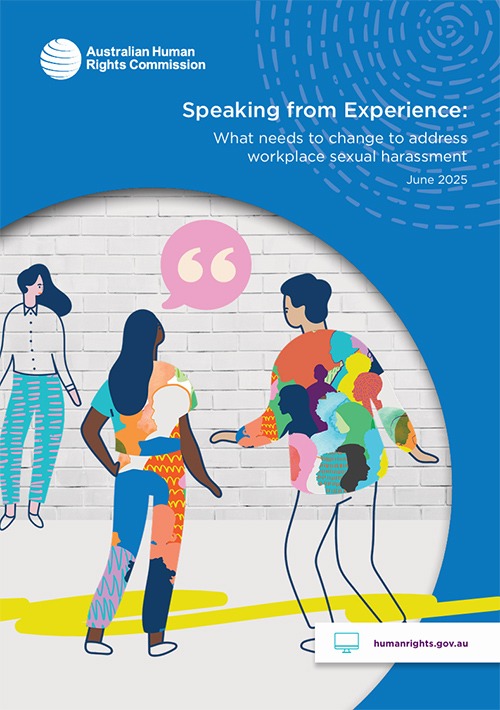
What needs to change to address workplace sexual harassment. June, 2025
Executive summary
This report addresses a gap in what workers from diverse backgrounds think needs to change to make workplaces safer. The Speaking from Experience project brings lived experience insights into the national conversation on workplace sexual harassment (WSH). The past decade has seen a change in the national approach to preventing and responding to WSH, and legal and policy reform has placed a greater responsibility on employers to create safe workplaces. Despite this, policy and practice gaps exist, particularly for people less likely to have secure employment, and who are more likely to be harassed.
In 2022, Time for Respect: Fifth national survey on sexual harassment in Australian workplaces (Time for Respect) found that in the last 5 years, one in three Australian workers (33%) had been sexually harassed at work. This figure was much higher for particular groups of workers, with:
- 47% of young people aged between 15 17;
- 46% of people who identified as gay, lesbian, bisexual, pansexual, queer, asexual, aromantic, undecided, not sure, questioning, or other;
- 70% of people with variations of sex characteristics or who identified as intersex;
- 56% of Aboriginal and Torres Strait Islander people;
- and 48% of people with a disability.
Since the launch of the Australian Human Rights Commission’s Respect@Work report in 2020, we have seen new frameworks for engaging with lived experience that have shaped the way that policymakers engage with victim-survivors as experts.6 For the first time, victim-survivors were given a voice in the National Plan to End Violence against Women and Children 2022-32.7 Despite these changes, there remains a gap in how victim survivors of WSH shape response, prevention and law reform. This gap is particularly acute for victim-survivors who face intersecting forms of discrimination and harassment. Through partnership with organisations and community groups across the country, the Speaking from Experience team met people where they are at, giving them choice and control over their voice – something often denied by harassers.
This report draws on their voices, using case studies and first-hand quotes from over 300 victim-survivors of WSH, “contributors” to the project. What we learnt was that WSH was not only an issue of gender and power. It also relates to other forms of discrimination such as race, migration status, sexuality, gender identity, disability, First Nations status and age. People bring their whole selves to work – their visa status, their level of social support and their ties to community and belonging. WSH can disrupt all spheres of life and harassers are more likely to target workers who have more to lose.
Contributors were asked what they think a helpful response to WSH would look like, what an unhelpful response would look like, and what they think needs to change to make workplaces safer in Australia. Barriers to safety included insecure work, a lack of diversity in leadership and unhelpful workplace responses, ranging from a lack of accessible information to a lack of person centred and culturally appropriate responses. In contrast, it was considered helpful when safety at work was a normal and expected part of the job, people were believed and supported, and actions towards justice were taken, even if this looked different from one person to another. In response to what we were told needs to change, we developed a range of resources which can be accessed on the Australian Human Rights Commission website.
These resources help workers, employers and advocates to prevent and respond to WSH. In addition to the resources, this report helps policy makers and service providers prioritise action, making recommendations for change in the areas of community awareness and action, safety and support, and accountability and justice. In some cases, contributors may be drawing on experiences that pre-date Respect@Work implementation, including the introduction of the positive duty into the Sex Discrimination Act 1984 (Cth) (Positive Duty) in 2022. However, their collective insights speak to the importance of these reforms and the relationship between inclusive, stable and safe workplaces. Filling this gap is critical for building the capacity of policy makers, employers (workplaces), and the workforce more broadly, to better understand and respond to WSH.