Statistics about LGBTIQA+ rights
Learn more about LGBTIQA+ people in Australia through statistics.
LGBTIQA+StudentsTeachers
Factsheet
21 January 2026
Introduction
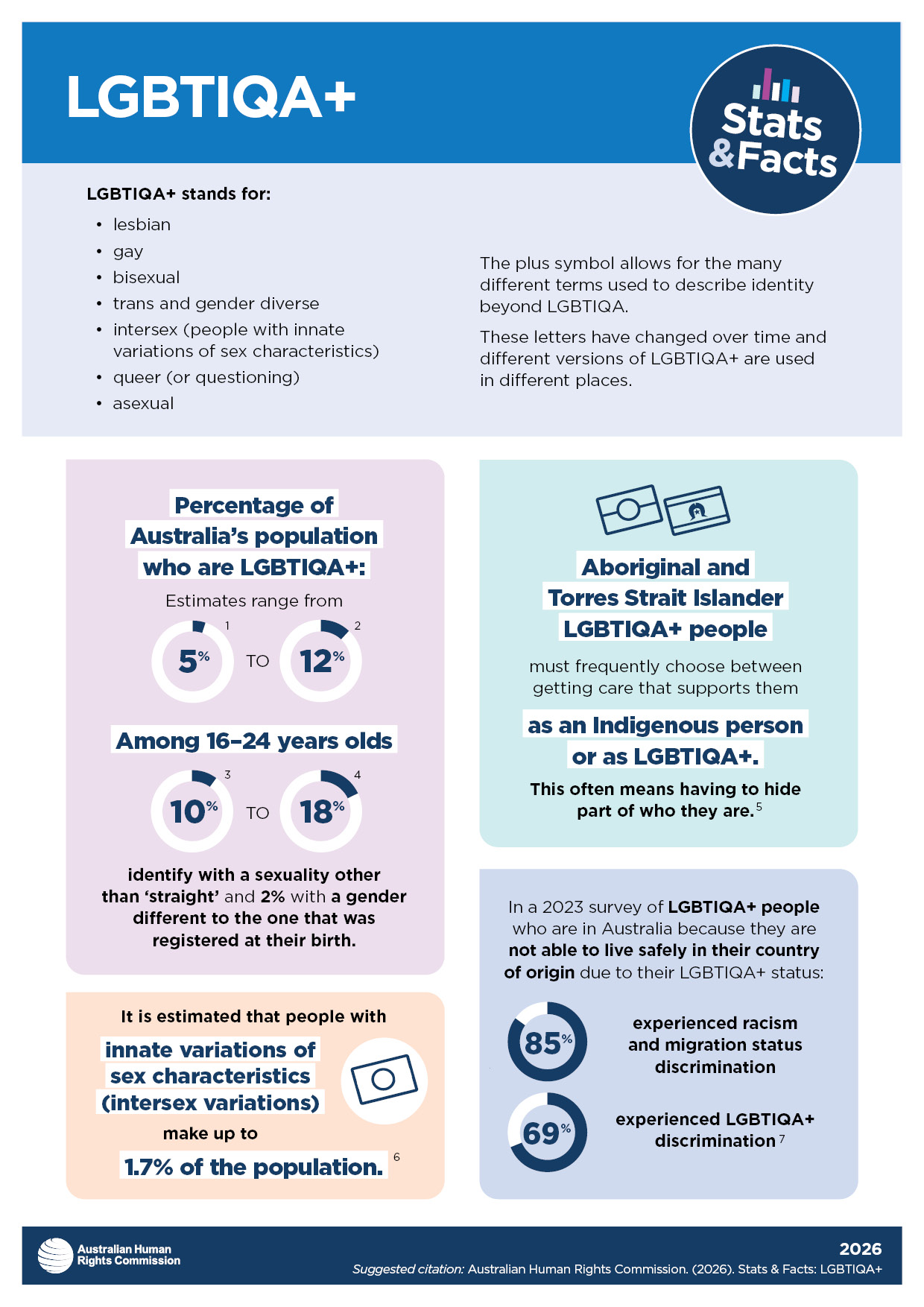
LGBTIQA+ stands for:
- lesbian
- gay
- bisexual
- trans and gender diverse
- intersex (people with innate variations of sex characteristics)
- queer (or questioning)
- asexual
- with the plus symbol to allow for the many different terms used to describe identity beyond LGBTIQA.
These letters have changed over time and different versions of LGBTIQA+ are used in different places.
19/08/2025
Demographics
- Percentage of Australia’s population who are LGBTIQA+:
- Among 16–24 years olds, 10%[3] – 18%[4] identify with a sexuality other than ‘straight’ and 2% with a gender different to the one that was registered at their birth.
Experiences of Indigenous LGBTIQA+ people
- Indigenous LGBTIQA+ people must frequently choose between getting care that supports them as an Aboriginal or Torres Strait Islander or as LGBTIQA+. This often means having to hide part of who they are.[5]
- In a 2023 survey, 43% of young Indigenous people had heard rude, hurtful or ignorant comments about their identity when accessing LGBTIQA+ health services.[6]
LGBTIQA+ people who have come to Australia because they are not able to live safely in their country of origin
- In a 2023 survey of LGBTIQA+ people who are in Australia because they are not able to live safely in their country of origin due to their LGBTIQA+ status:
- 85% experienced racism and migration status discrimination
- 69% experienced LGBTIQA+ discrimination
- The most common places participants reported experiencing discrimination were in:
- employment: 69%
- education: 53%
- housing: 51% [7]
People with intersex variations
- It is estimated that people with innate variations of sex characteristics (intersex variations) make up to 1.7% of the population.[8]
- People with intersex variations continue to campaign to be included in the Australian Census in a meaningful way.[9]
Older LGBTI people
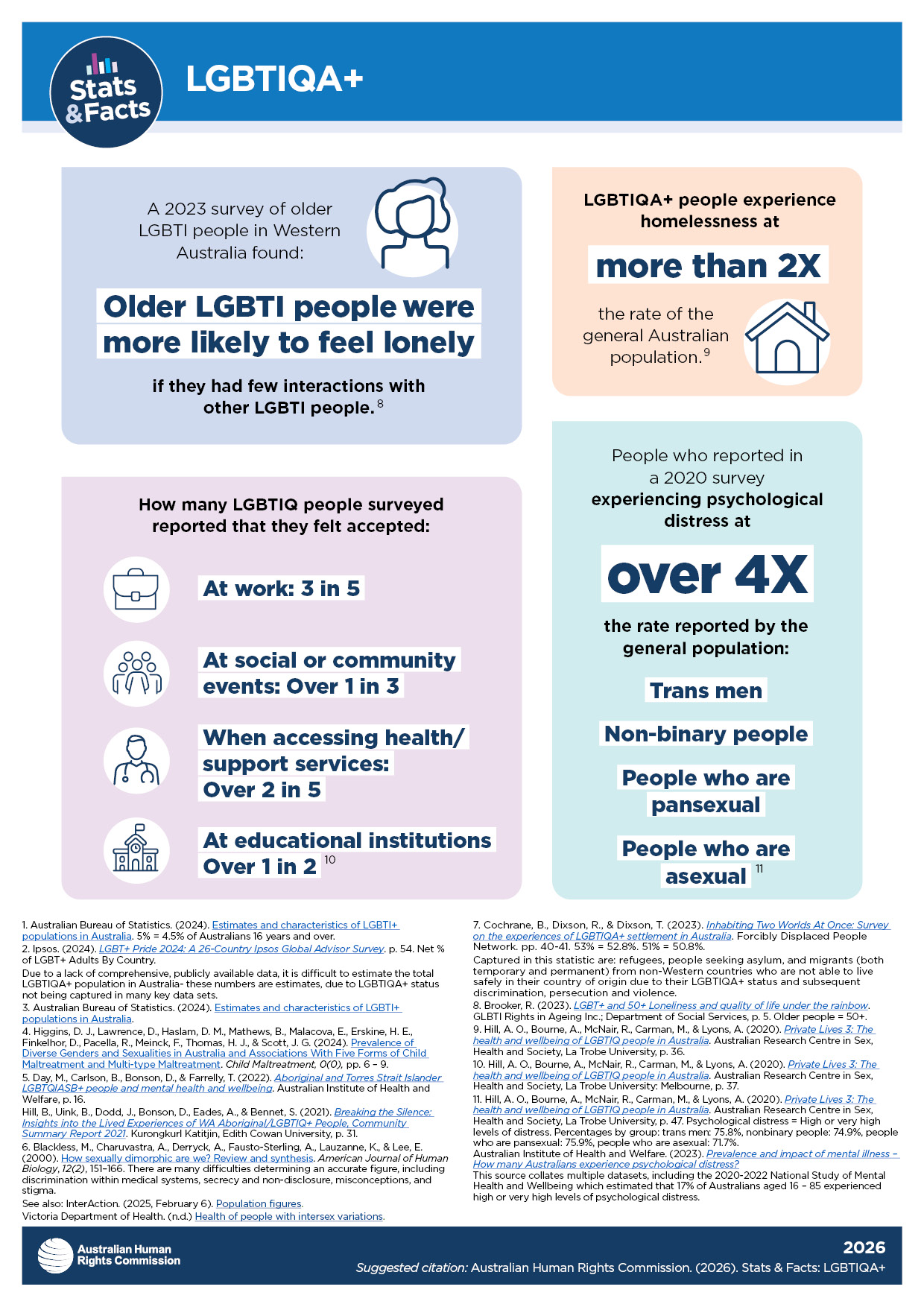
- A 2023 survey of older LGBTI people in Western Australia found:
Acceptance and inclusion
- How many LGBTIQ people surveyed reported that they felt accepted:
- at work - 3 in 5
- at social or community events - more than 1 in 3
- when accessing health/support services - more than 2 in 5
- at educational institutions - more than 1 in 2.[12]
Living together and marriage
- 78,425 same-sex couples were living together in Australia in 2021, a 68% increase since 2016.[13]
- 1 in 3 of these same-sex couples were married.[14]
Experiencing homelessness
- LGBTIQA+ people experience homelessness at more than twice the rate of the general Australian population.[15]
Mental health
- In a 2023 survey of young Indigenous LGBTQA+ people:
- nearly 70% said they experienced or had been diagnosed with depression
- 64% had generalised anxiety
- 35% had an eating disorder.[16]
- Of all LGBTQA+ people, 75% have experienced a mental disorder at some time in their life, compared with 42% of heterosexual people.[17]
- In a 2020 survey,
- trans men
- non-binary people
- people who are pansexual
- people who are asexual
reported experiencing psychological distress at over 4 times the rate reported by the general population.[18]
Downloads
Suggested citation
- Suggested citation: Australian Human Rights Commission (2026) Stats & Facts: LGBTIQA+ rights.
References
- [1] Australian Bureau of Statistics. (2024). Estimates and characteristics of LGBTI+ populations in Australia. 5% = 4.5% of Australians 16 years and over
- [2] Ipsos. (2024). LGBT+ Pride 2024: A 26-Country Ipsos Global Advisor Survey. p. 54. Net % of LGBT+ Adults By Country.
Due to a lack of comprehensive, publicly available data, it is difficult to estimate the total LGBTIQA+ population in Australia- these numbers are estimates, due to LGBTIQA+ status not being captured in many key data sets. - [3] Australian Bureau of Statistics. (2024). Estimates and characteristics of LGBTI+ populations in Australia.
- [4] Higgins, D. J., Lawrence, D., Haslam, D. M., Mathews, B., Malacova, E., Erskine, H. E., Finkelhor, D., Pacella, R., Meinck, F., Thomas, H. J., & Scott, J. G. (2024). Prevalence of Diverse Genders and Sexualities in Australia and Associations With Five Forms of Child Maltreatment and Multi-type Maltreatment. Child Maltreatment, 0(0), pp. 6 – 9. 1 in 5 = 17.7%.
- [5] Day, M., Carlson, B., Bonson, D., & Farrelly, T. (2022). Aboriginal and Torres Strait Islander LGBTQIASB+ people and mental health and wellbeing. Australian Institute of Health and Welfare, p. 16.
Hill, B., Uink, B., Dodd, J., Bonson, D., Eades, A., & Bennet, S. (2021). Breaking the Silence: Insights into the Lived Experiences of WA Aboriginal/LGBTIQ+ People, Community Summary Report 2021. Kurongkurl Katitjin, Edith Cowan University, p. 31. - [6] Liddelow-Hunt, S., Uink, B., Daglas, K., Hill, J.H.L., Hayward, L., Stretton, N., Perry, Y., Hill, B., & Lin, A. (2023). Walkern Katatdjin (Rainbow Knowledge) Phase 2 National Survey Community Report, p. 50. The ‘I’ representing people with intersex variations in the LGBTQA+ acronym has not been included here, as data on this group was not recorded in this particular study.
- [7] Cochrane, B., Dixson, R., & Dixson, T. (2023). Inhabiting Two Worlds At Once: Survey on the experiences of LGBTIQA+ settlement in Australia. Forcibly Displaced People Network. pp. 40-41. 53% = 52.8%. 51% = 50.8%. Captured in these statistics are: refugees, people seeking asylum, and migrants (both temporary and permanent) from non-Western countries who are not able to live safely in their country of origin due to their LGBTIQA+ status and subsequent discrimination, persecution and violence.
- [8] Blackless, M., Charuvastra, A., Derryck, A., Fausto-Sterling, A., Lauzanne, K., & Lee, E. (2000). How sexually dimorphic are we? Review and synthesis. American Journal of Human Biology, 12(2). pp 151–166. There are many difficulties determining an accurate figure, including discrimination within medical systems, secrecy and non-disclosure, misconceptions, and stigma. See also:
InterAction. (2025, February 6). Population figures.
Victoria Department of Health. (n.d.) Health of people with intersex variations. - [9] Carpenter, M. (2022, September 27). The last census, and the next. Intersex Human Rights Australia.
- [10] Brooker, R. (2023). LGBT+ and 50+ Loneliness and quality of life under the rainbow. GLBTI Rights in Ageing Inc.; Department of Social Services, p. 5. Older people = 50+. This study was conducted in Western Australia only.
- [11] Brooker, R. (2023). LGBT+ and 50+ Loneliness and quality of life under the rainbow. GLBTI Rights in Ageing Inc.; Department of Social Services, p. 5.
- [12] Hill, A. O., Bourne, A., McNair, R., Carman, M., & Lyons, A. (2020). Private Lives 3: The health and wellbeing of LGBTIQ people in Australia. Australian Research Centre in Sex, Health and Society, La Trobe University: Melbourne. p. 37.
- [13] Australian Bureau of Statistics. (2022, December 2). Same-sex couples living together in Australia.
- [14] Australian Bureau of Statistics. (2022, December 2). Same-sex couples living together in Australia.
- [15] Hill, A. O., Bourne, A., McNair, R., Carman, M., & Lyons, A. (2020). Private Lives 3: The health and wellbeing of LGBTIQ people in Australia. Australian Research Centre in Sex, Health and Society, La Trobe University. p. 36.
- [16] Liddelow-Hunt, S., Uink, B., Daglas, K., Hill, J.H.L., Hayward, L., Stretton, N., Perry, Y., Hill, B., & Lin, A. (2023). Walkern Katatdjin (Rainbow Knowledge) Phase 2 National Survey Community Report. Young people = 14 – 25 years). Nearly 70% = 68.1%. 35% = 34.7%. p. 39.
- [17] Australian Bureau of Statistics. (2024). Mental health findings for LGBTQ+ Australians. 75% = 74.5%. 42% = 41.7%.
LGB+ in this data represents people who described their sexual orientation as gay or lesbian, bisexual, or who used a different term (such as asexual, pansexual or queer.
“Mental disorder”: in the National Study of Mental Health and Wellbeing three groups of mental disorders were assessed – Anxiety, Affective and Substance Use disorders – based on definitions and criteria of the World Health Organization International Classification of Diseases, Tenth Revision (ICD-10). - [18] Hill, A. O., Bourne, A., McNair, R., Carman, M., & Lyons, A. (2020). Private Lives 3: The health and wellbeing of LGBTIQ people in Australia. Australian Research Centre in Sex, Health and Society, La Trobe University, p. 47. Psychological distress = High or very high levels of distress. Percentages by group: trans men: 75.8%, nonbinary people: 74.9%, people who are pansexual: 75.9%, people who are asexual: 71.7%. Australian Institute of Health and Welfare. (2023). Prevalence and impact of mental illness – How many Australians experience psychological distress?
This source collates multiple datasets, including the 2020-2022 National Study of Mental Health and Wellbeing which estimated that 17% of Australians aged 16 – 85 experienced high or very high levels of psychological distress.