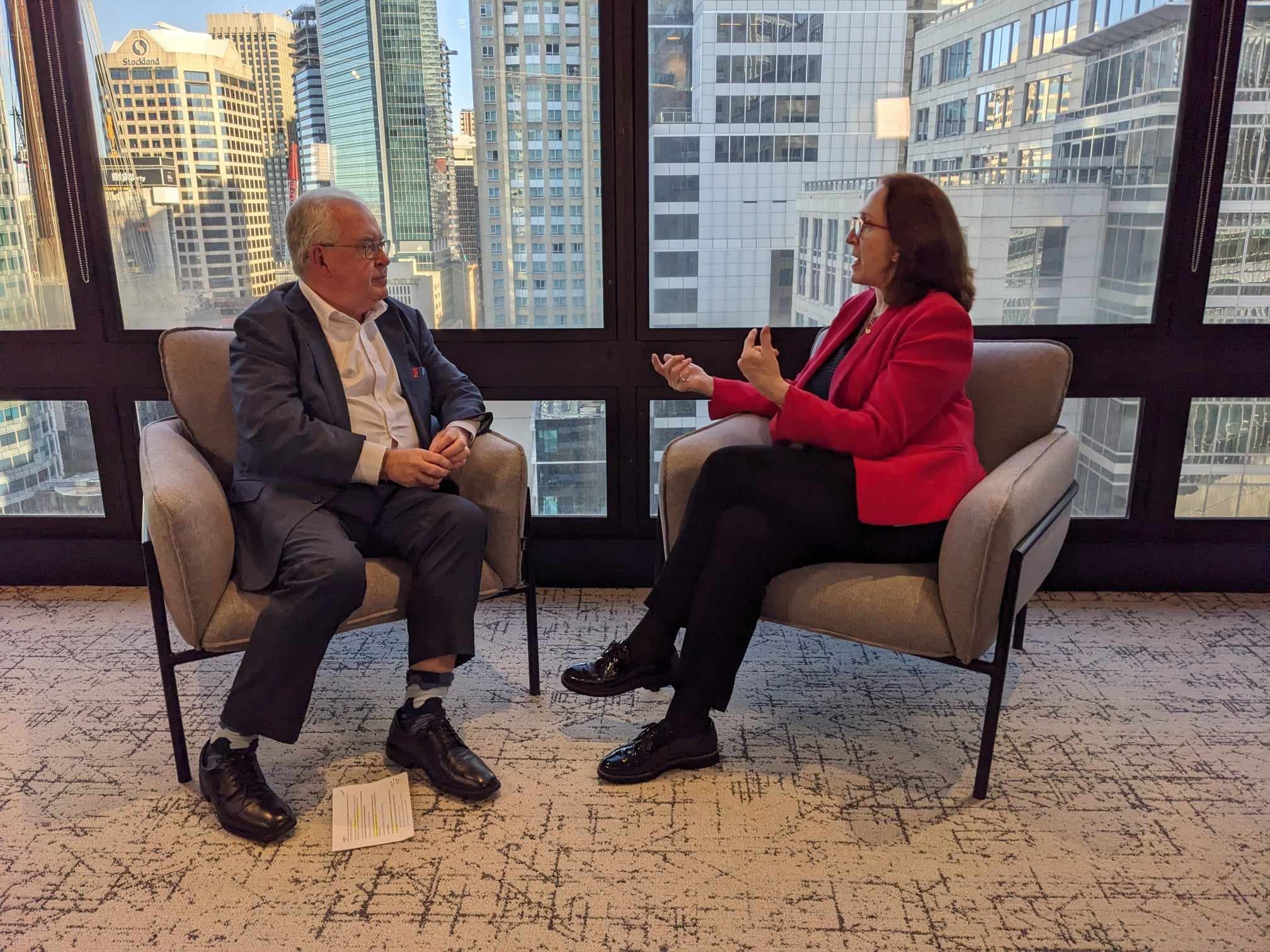
Together, they discuss what ageing well means to them and the barriers, including ageism, loneliness, juggling responsibilities and access to care.
Latest Episode: Professor Henry Brodaty AO
In this episode of Let's Talk Ageing, Senior Australian of the Year Professor Henry Brodaty AO joined Robert Fitzgerald to reflect on ageing, dementia and care. He spoke of ageing as a time of wisdom and possibility, arguing that older age should be our “golden age.”
He added this can be sustained by a positive mindset, while stressing the urgent need for better responses to older people with complex needs in hospitals as Australia’s population ages.
Episode 29: Geraldine Doogue AO
In this episode of Let’s Talk Ageing, broadcaster Geraldine Doogue reflects on her personal experience of ageing and the broader societal challenges facing older Australians. She describes ageing as a period of increased clarity, stronger judgement, and deeper contentment, while also acknowledging the risks of losing purpose and feeling irrelevant.
Geraldine emphasises the importance of recognising the continued value older people bring to society and encourages individuals to actively define their own “act of joy”.
Episode 28: Dr Nola Ries
In this month's Let’s Talk Ageing episode we hear from health equity lawyer, academic and researcher, Dr Nola Ries. Nola’s research spans across many areas related to ageing, including examining the dominant myths around ageing and decline, the uptake and quality of advance legal planning among older adults, and exploring the experiences of solo agers.
Her work aims to minimise the risks of financial elder abuse, reduce the fear associated with ageing, and support positive ageing. Her personal goals as she ages include mastering the piano, deadlifting as much as an older woman at her gym and finding more social connections.
Question:
What does getting older mean to you, and why?
Dr Nola Ries:
To me, getting older is an opportunity for continued growth. Longevity runs in my family, which shapes my outlook. Much of my adult life has focused on education and career (five university degrees and living in three countries), but ageing offers space to keep growing – physically, cognitively and socially. I love fitness and aim to get even stronger, inspired by a 72‑year‑old woman at my gym whose impressive deadlift I aspire to match. I also took up piano a few years ago and am steadily improving. By 90, who knows how good I might be? I’m keen to find out – and to invest more in social connections, which are vital for wellbeing in older age.
Question:
What do you see are the key challenges people face as they get older?
Dr Nola Ries:
Ageism is the central challenge. Nearly a decade ago, when I designed UTS’s Elder Law subject – one of the first of its kind in Australia – I asked students to draw a ‘typical’ client. Most images centred on frailty and isolation: a single, wrinkled or bald figure, using a cane or wheelchair, or just a disembodied face surrounded by dentures and hearing aids. Only two drawings showed older people in relation to others — a stylish couple walking a dachshund, and a smiling woman encircled by a supportive network. The exercise revealed how ageist assumptions can be carried, often unconsciously, into professional practice.
Question:
Tell us about the work/research you’ve been doing to address these challenges?
Dr Nola Ries:
My work focuses on two areas: dementia capability in the legal profession and legal issues affecting ‘solo’ agers. Research with lawyers and people impacted by dementia led to the development of attributes for a dementia‑capable lawyer, along with well‑received online training for legal professionals. I’m now collaborating with Dementia Australia on further education and legal information resources. Australian law and policy often overlooks ‘solo’ agers — older people who, by choice or circumstances, lack trusted family or close networks. This research examines legal needs, end‑of‑life planning, and alternatives to reliance on public guardianship, and is supported by the Wicking Trust and the Australian Research Council.
Question:
How can others get involved or support this work?
Dr Nola Ries:
Please feel free to get in touch: nola.ries@uts.edu.au. I’m keen to hear from anyone interested in the intersection of law, health and ageing – including professionals, as well as people who identify as solo agers. For the rest of 2026 we will be interviewing solo agers, people who have been impacted by the death of a solo ageing person (such as distant or estranged kin), service providers across legal, health, allied and death care sectors about their experiences with solo agers. The next phase of the work will develop practical resources on legal issues for solo agers. We’re also launching a four‑year ARC‑funded project involving a national survey on solo ageing, case studies on community and professional services, and a series of roundtables. There will be many opportunities to connect and contribute.
Episode 27: Dr Susan Cochrane
In this episode of Let’s Talk Ageing, published to coincide with World Elder Abuse Day (WEAAD), we hear from, Dr Susan Cochrane, National Policy Manager at Relationships Australia.
Marked annually on June 15, WEAAD unites communities globally to raise awareness about the abuse and mistreatment of older people in all its forms.
Susan is right in the thick of it – advocating for policy change and working collaboratively with frontline services and advocacy groups to address ageism, promote the rights of people as they age and address the inequities faced by older adults experiencing harm. She aspires for a safer, more vibrant society for future generations.
Question:
How do you see yourself in older age, why is this so?
Dr Susan Cochrane:
In 20 years, I will be in my late 70s. My aspiration is to be participating in social, economic and legal reforms that enhance people’s daily lives. I hope, too, to maintain the relationships and activities I currently cherish, while always retaining the curiosity to nurture new ones. I am so fortunate that my role with Relationships Australia brings me into daily contact with many people in later adulthood, who live energetic, fulfilling lives fuelled by intellectual and emotional curiosity, and whose ambition to foster a safer, more vibrant society for future generations is tenacious and unwavering.
Question:
What do you see are the key challenges people face as they get older?
Dr Susan Cochrane:
Ageism in later adulthood is so hardwired into our political, economic, cultural, health and legal systems that it is highly effective, highly camouflaged, and barely challenged. From ageism emerges challenges as concrete as getting and keeping a job even in your 40s, and as visceral as being valued as a person beyond workforce participation. Ageism exposes you to risks of inappropriate medical interventions and coercive measures to make you ‘behave’; of having your right to make decisions over-ruled ostensibly in your ‘best interests’; and, if your rights are violated, of having your right to a legal remedy stripped from you.
Question:
Tell us about the work/research you’ve been doing to address these challenges?
Dr Susan Cochrane:
Governments must be shaken out of their chronic disinterest in older adults. Our priorities aren’t just aged care and health services. I tell governments that ageing doesn’t mean that rights, relationships, individuality and dignity become less important. I tell them that ageing must not mean separation from the world in the name of ‘safety’. I insist that harming older adults is as wrong as harming younger adults, and that we should have access to support for our rights, choices and cherished relationships wherever we are and regardless of our financial circumstances.
Question:
How can others get involved or support this work?
Dr Susan Cochrane:
Similar to physical objects in Newton’s first law, political inertia is best disrupted by another object or force causing friction or discomfort. Accordingly, to effectively assert and protect our rights as we (and later generations) age, we need increasing numbers of us to demonstrate that there are political consequences for remaining inert and disinterested. Join advocacy campaigns like EveryAGE Counts, Rights of Older Persons Australia, and the Global Alliance for the Rights of Older People. Be vocal with politicians. Challenge ageism, including our internalised ageism, in our daily lives.
Episode 26: Ian Roberts
In this episode of Let’s Talk Ageing, we sit down with Ian Roberts, former NRL player, the first openly gay player in the league, and now an ambassador for ConneCTErs: Survivors of Chronic Head Injury, to explore masculinity, sport and ageing.
Ian brings a powerful and thoughtful perspective as he reflects on the culture of toughness in sport and how it has shaped ideas of strength, resilience and self-reliance over time. While these messages are often learned early, Ian also speaks to the opportunities that come with ageing to question, reshape and broaden what strength can look like.
Ian discusses how moving beyond traditional expectations can create space for honesty, connection and support, and how later life can be a time of growth, openness and a renewed understanding of ourselves and each other.
Episode 25: Sue Hendy
In this Let’s Talk Ageing episode, we hear from Sue Hendy, older persons’ advocate, Co-chair of the Commission’s Human Rights as We Age Network, Director of the International Federation on Ageing, and former CEO of Victoria’s Council of the Ageing. Sue speaks about how her great aunt reshaped her understanding of ageing and possibility. From learning the piano at 82 to living a life grounded in community and contribution, her aunt showed Sue that it is often attitudes to ageing — not ageing itself — that limit opportunity.
Sue reflects on ageism as one of the greatest barriers to ageing well, how it quietly lowers expectations, and why challenging these assumptions is essential. She also shares how her work across community fitness, advocacy and human rights is focused on supporting strength, capacity and dignity as we age.
Question
Tell us about an older or younger person whose perspective unsettled or expanded your own, how did they help you see age beyond the stereotypes?
Sue Hendy
My Great Aunt was a significant influence on my life and my perspective on ageing. She and her husband were very involved in community and charity and were very active during their working life and into life after paid work.
At 82 my aunt required hip surgery. She celebrated this, as it gave her time to learn the piano, a lifelong desire.
It demonstrated that life can be full at all ages and it is attitudes to ageing, ours and that of others, that often gets in the way. It set the wheels in motion for my career.
Question
From your perspective, what are the most significant rights, equity, or societal challenges people face as they age?
Sue Hendy
Ageism and discrimination towards older people are our greatest challenge to ageing well. Our present and future selves are potentially diminished, and self‑expectations are reduced as a result.
This includes accepting that when things are going wrong it is inevitable, which then leads to people not seeking to remedy or fix the issue.
An international treaty and an Australian Human Rights Act will go a long way to enabling us to eradicate ageism.
Question
Please share an overview of the work you are leading to address these challenges. What drives your approach?
Sue Hendy
I work as a Fitness Instructor (volunteer) in our local community gym, which I helped establish. We are encouraging all people, but particularly older people, to do progressive resistance weight training. Maintaining strength and capacity is both possible and important.
I am a Director of the International Federation on Ageing (IFA), the international peak advocacy body, which advocates on policy and programs for older people.
I co‑chair the Human Rights as We Age Network in Australia and am a Director of Doutta Galla Aged Services, a not‑for‑profit providing a range of care services to older people.
Question
How can individuals, organisations or communities contribute to or strengthen this work?
Sue Hendy
The best way to change our ageing and our future is for all of us to question any reference to age. Is the comment ageist or derogatory in any way? Is using age relevant? Are the assumptions about age correct?
If there is an ageist element, call it out. Ageism is deeply ingrained in our society. Now it is time to challenge it.
Episode 24: Professor Shirley Randell AO
Staying Active, Connected and engaged
In this month’s Let’s Talk Ageing episode we hear from 86 year old Professor Shirley Randell AO, Ambassador for the National Older Women’s Network.
Shirley is very active, speaking at Australian and overseas conferences and staying connected with her extended family.
Question:
What does getting older mean to you, and why?
Professor Shirley Randell:
I am now 86 years old and live alone in a one-room apartment in an apartment building in the city.
I have four children, 17 grandchildren and 11 great grandchildren – a happy family who regularly keep in touch with me.
I am ageing happily, enjoy travelling overseas, and serving on various professional committees as an Ambassador and office bearer.
Question:
What do you see are the key challenges people face as they get older?
Professor Shirley Randell:
Health – osteoarthritis, I have had one knee replacement and will have surgery on the other knee. I have an excellent GP and a good chemist for medicines.
Also, housing, illness, poverty, loneliness, friendships and family.
Question:
Tell us about the work/research you’ve been doing to address these challenges?
Professor Shirley Randell:
I keep myself active. I attend and speak at Australian and overseas conferences, have two strong friendship groups and some special friends.
I am President of organisations I appreciate working with, and I am active on Facebook and Linkedin.
Question:
How can others get involved or support this work?
Professor Shirley Randell:
I am an ambassador for older people, homeless people and women’s education. I seek help for writing or speaking tasks from family and friends. For more information on the work I support go to https://ownaustralia.org.au/
Episode 23: Violet Roumeliotis AM
Helping older people from CALD communities
In this month’s Let’s Talk Ageing episode we hear from Violet Roumeliotis AM, CEO of Settlement Services International (SSI), a national not-for-profit organisation which started in 2000 with the aim of helping newly arrived refugees settle in Australia and now delivers human and social services to people from diverse cultural and linguistic backgrounds.
Violet reflects on the challenges facing older people from diverse cultures and the lessons from her Greek father, who taught her that ‘every age has its beauty’.
Question:
Who is an older or younger person who has had an impact on your life and how?
Violet Roumeliotis:
My father, a migrant who fought in the Greek civil war, shaped my values deeply. He had a saying that every age has its beauty. He would talk about the wisdom, confidence
and significance of reaching an older age and how important it was to reflect on the gift of ageing and the opportunities being older brought. Like having the time to listen, learn and share insights and stories with family friends and loved ones. His legacy guides me every day.
Question:
What do you see are the key challenges people face as they get older?
Violet Roumeliotis:
Culturally and linguistically diverse older Australians often face fragmented and inaccessible support systems. Language barriers, cultural misunderstandings, and a lack
of tailored services can leave them feeling excluded and underserved. Without coordinated, culturally responsive care, many struggle to navigate aged care, health services, and community programs. It’s critical to invest in inclusive systems that recognise diverse needs and ensure every older person can age with dignity and support.
Question:
Tell us about the work/research you’ve been doing to address these challenges?
Violet Roumeliotis:
Settlement Services International (SSI) is actively addressing key challenges faced by older Australians, particularly those from CALD communities, through targeted initiatives that improve access to support and reduce isolation. We’ve deployed community navigators via programs like Care Finder and Healthcare Navigation Support to connect CALD individuals with prevention services in priority local government areas. These navigators help overcome language and system barriers. We're also advocating for multi-agency collaboration to build coordinated, culturally responsive support systems that ensure older people can age with dignity and connection.
Question:
How can others get involved or support this work?
Violet Roumeliotis:
One way you can support this work is to get involved with SSI’s Healthcare Navigation Support program. Whether you’re a community health centre, GP clinic experienced with homeless populations, CALD or refugee organisation, faith leader, or specialist service provider, your expertise is invaluable. Partner with us to:
* Co-host information sessions tailored to your community’s needs
* Facilitate smooth client transfers and referrals to address complex health and social needs
* Strengthen our referral network to ensure holistic, culturally safe support
Together, we can make healthcare more accessible, inclusive, and empowering for those who need it most. For more information or to contact us go to: https://www.ssi.org.au
Episode 22: Hugh de Kretser
What rights for older Australians are often overlooked?
In the first episode of Let’s Talk Ageing for 2026, Australian Human Rights Commission President Hugh de Kretser joins Age Discrimination Commissioner Robert Fitzgerald for a wide-ranging conversation about ageing and human rights.
President de Kretser explains why many people take their rights for granted, and how ageing raises important human rights issues with significant implications that are often underappreciated or ignored.
Episode 21: Anna Bligh
The challenges with banking securely
Anna Bligh is the former Australian Banking Association CEO. Earlier this year, she spoke with the Age Discrimination Commissioner Robert Fitzgerald AM about various issues including financial elder abuse, the frustrations of having no champion to harmonise Power of Attorney laws across the country and the idea of ‘deliberately retiring’.
In this Let’s Talk Ageing episode, we hear from Anita Westera, President of the Australian Association of Gerontology (AAG). Anita shares that her role model for ageing is her mum, who worked as a young psychiatric nurse in Nazi-occupied Holland, smuggling food from the family garden to her patients. She migrated to Australia and raised seven children wither her husband, before returning to nursing in her 40s to work with older people living in aged care. 'Her humility, courage and tenacity continue to inspire me today,' Anita said.
As President of the AAG, Anita is involved with the annual AAG conferences. You can read more from Anita below.
Question:
Who is an older or younger person who inspires you and why?
Anita Westera:
The person who has inspired my ageing-related journey is my late mother. As a young psychiatric nurse in Nazi-occupied Holland during the winter famine of WW2, she smuggled food from the family garden into the hospital, past armed guards, to provide for her patients. Migrating to Australia she and my father raised seven children without any extended family for support, and despite significant health and financial struggles. Returning to nursing in her 40’s, mum worked night shift in a nursing home renowned for being a ‘last resort’ for people with severe dementia and/or mental health issues. Her humility, courage and tenacity continue to inspire me today.
Question:
What do you see are the key challenges people face as they get older?
Anita Westera:
My views are informed by close to four decades working across clinical, policy, research and advocacy contexts where I have seen first-hand the impact of government policy on health and well-being of older people. From my perspective, the most critical issue is the impact of successive decades of neoliberal and austerity policies that have reduced the capacity within government to deliver evidence-based policy and programs. The Royal Commission into Aged Care Quality and Safety described the effect of this in its Interim Report, aptly titled ‘Neglect’. There are now significant reforms underway to rebuild public sector capabilities, including supporting agencies and organisations to co-produce evidence and improve outcomes for older people; this is most welcome.
Question:
Tell us about the AAG has been doing to address these challenges?
Anita Westera:
As President of the Australian Association of Gerontology (AAG), my role is to work with the Board, CEO and staff to lead the organisation and members in connecting research, policy and practice to improve the experience of ageing. What drew me to the AAG in the first instance (several decades ago now) was the commitment of its diverse membership to working together to make things better, particularly for vulnerable populations with health and care needs. Today, our 1300+ members and small but dedicated staff work together to create and co-create new knowledge, build communities of interest and practice, as well as help grow the next generation of leaders in research and practice through our knowledge translation activities and grants programs.
Question:
How can others get involved or support this work?
Anita Westera:
The ethos of the AAG is very much about working together to achieve implementable and sustainable change, not only within our membership but also across sectors, disciplines and jurisdictions, nationally as well as internationally. AAG invites all who are interested in supporting evidence-informed policy and practice to join us in that journey!
Check out our national conference, Ageing at the Centre, being hosted 11-14 November in the Northern Territory or more general information about AAG at https://www.aag.asn.au/
Episode 19: Mary Ann Baquero Geronimo
Resilience of emerging cultural groups
As Chief Executive Officer of the Federation of Ethnic Communities’ Councils of Australia (FECCA) Mary Ann Baquero Geronimo brings a cultural perspective to the conversation on ageing.
Episode 18: Cassara Hardie
A First Peoples perspective
Cassara Hardie is a proud Dunghutti woman, and Acting Chief Executive Officer of the National Aboriginal and Torres Strait Islander Ageing and Aged Care Council. Cassara shares her personal journey of reconnecting with culture and her commitment to supporting First Nations Elders and Older People.
Episode 17: Professor Tanya Buchanan
Ageing and brain health
Professor Tanya Buchanan is Chief Executive Officer of Dementia Australia. Tanya sees ageing as an opportunity to continue to develop new skills and wisdom, which plays an important role in maintaining brain health and reducing the risk of dementia.
Question:
What does getting older mean to you, and why?
Professor Tanya Buchanan:
Getting older for me means the opportunity to continue to develop new skills and wisdom. I am also incredibly privileged to be surrounded by passionate and clever people in my work and home life who encourage me to continue to learn. As I get older, I become increasingly aware of how much of a privilege it is to age and to age well. So for me I am very focused on looking after my health, including my brain health by staying physically and mentally active.
Question:
What do you see are the key challenges people face as they get older?
Professor Tanya Buchanan:
Dementia is the second leading cause of death of all Australians and provisional data suggests it will soon be the leading cause. Our research shows that there has been a concerning lack of awareness and understanding about dementia in the community – with many Australians mistakenly believing dementia is a normal part of ageing.
The lack of knowledge and understanding of dementia in our communities has substantial negative impacts on people living with dementia, their families and carers.
Low awareness contributes to discrimination, stigma and isolation. Poor understanding creates barriers to timely diagnosis and to accessing ongoing medical and social care.
Question:
Tell us about the work/research you’ve been doing to address these challenges?
Professor Tanya Buchanan:
It is never too early or too late to reduce dementia risk. While we cannot change getting older, genetics or family history, scientific research shows that looking after our brain health can make a big difference to reducing or delaying the risk of developing dementia. That’s why Dementia Australia is calling for critical investment from the Federal Government to support a national conversation on brain health, combined with more targeted and effective supports for people impacted by dementia. Taking this dual approach will ensure we are working towards reducing the impact of all forms of dementia.
Question:
How can others get involved or support this work?
Professor Tanya Buchanan:
Being brain healthy is relevant at any age, whether you are young, old or in between. However, it is particularly important once you reach middle age as this is when changes start to occur in the brain. Some ways we can look after our brain health include:
Stay social, enjoy the company of others
Try new things, like a new exercise routine
Learn a new hobby like painting or sewing.
For more information, please visit www.dementia.org.au or contact the National Dementia Helpline on 1800 100 500.
Episode 16: Chris Grice
Staying socially connected
Chris Grice is Chief Executive Officer of National Seniors Australia. He shares insights how health, social connections, and financial circumstances shape the ageing experience.
Question:
Who is an older or younger person who inspires you and why?
Chris Grice:
There are few people aged in their nineties with the passion, drive, and ambition to ‘make tomorrow better’ than Everald Compton AO.
While Everald’s achievements included starting National Seniors Australia in 1976 are admirable, I most admire his capacity to connect with people and cast aside challenges that would cause others to be disheartened and defeated. This has undoubtedly helped him to attain success for older Australians and others through National Seniors.
Whether he is defending, protecting, and promoting the interest of older Australians, fighting ageism or increasing awareness and understanding around dementia – Everald Compton personifies my personal and professional mantra that ‘Experience Matters’. He is a formidable and inspirational role model.
Question:
What do you see are the key challenges people face as they get older?
Chris Grice:
Not everyone has the privilege to get older. For those who do, getting older can bring with it more time for family, friends, and travel; wisdom, the ability to ‘not sweat the small stuff’ and confidence in one’s own skin. Getting older can also bring loss of social connections due to family and friends passing away; loneliness; physical health conditions or cognitive decline that can limit or prevent participation in hobbies and social activities; battles against ageism; perceived and real vulnerability; and keeping up with an increasingly digital economy and everchanging world. Both the ‘pros’ and the ‘cons’ can be impacted by health, social and financial circumstances. They highlight the importance of remaining socially connected – no matter how challenging this can be, and the need for universal kindness and respect.
Question:
Tell us about the work/research you’ve been doing to address these challenges?
Chris Grice:
Every year National Seniors Australia (NSA) conducts a social survey capturing the views and experiences of thousands of older Australians aged 50-plus.Last year we included a module about people’s experiences of ageism in everyday life. Nearly everyone reported experiences of ageist attitudes and actions from others, especially in retail and service settings, or when seeking employment. People who were socially or financially disadvantaged, who were older or in poorer health were even more likely to experience ageism.
Our survey findings are publicly available on our website and are used in state and federal government submissions, advocacy campaigns, and public reports—helping to raise awareness and drive real change.
Question:
How can others get involved or support this work?
Chris Grice:
Regardless of people’s individual circumstances, working with independent and influential bodies such as the Human Rights Commission, while effectively advocating to government on their behalf, is key to bringing about policies that make a meaningful difference. As a peak consumer body that defends, protects, and promotes the interests of older Australians, NSA is best placed to influence these policies. NSA members inform our research and shape our advocacy agenda on issues including ageism, elder abuse, the age pension and aged care. The more members we have, the stronger our influence. We invite older Australians to help NSA continue our important work by participating in our research and surveys, and by becoming a part of the National Seniors Australia community.
Episode 15: Bev Lange
Supporting older people at risk of abuse
Bev Lange is Executive Officer of Elder Abuse Action Australia’s (EAAA). She reflects on growing older, kindness and diversity.
Episode 14: Yumi Lee
Homelessness and older women
Yumi Less is Chief Executive of the Older Women’s Network NSW. She talks about the rights, dignity and wellbeing of older women and survival in a world that fails to plan for older women's futures.
Question:
How do you see yourself in older age, why is this so?
Yumi Lee:
Prior to working for the Older Women’s Network (OWN), I never seriously considered what my 70s and 80s might look like. Ageism makes ageing seem undesirable, reinforced by the billions spent globally on anti-ageing creams! Society teaches us to resist ageing rather than embrace it. But in working with older women in OWN, I see the strength and ongoing contributions of older women. Yet, I also see the fear of homelessness— something I, too, could face. Without enough savings or superannuation, financial insecurity is real for me and others like me. Ageing is not just about wisdom and resilience; it’s about survival in a world that fails to plan for older women’s futures.
Question:
What do you see are the key challenges people face as they get older?
Yumi Lee:
One of the greatest challenges older women face is being overlooked by policymakers, politicians, and society. Despite being the fastest-growing group at risk of homelessness, older women are rarely included in housing policies – for example, in NSW we don’t even have silver building standards! Superannuation systems fail to account for career breaks due to unpaid caregiving. Employment policies focus on younger workers. Healthcare systems overlook gendered ageing, with research and services often centred on men. Even aged care policies fail to address older women’s specific needs. Without systemic change, ageing remains a struggle in a world that refuses to plan for ageing women.
Question:
Tell us about your work and what you’ve been doing to address these challenges?
Yumi Lee:
The Older Women’s Network (OWN) has been driving systemic change to address the urgent challenges older women face for nearly 40 years. Our Pathways to Employment program assists older women to get back to the paid workforce. The Homes for Older Women (HOW) program in the Blue Mountains links older women facing homelessness with compassionate homeowners. OWN is also working hard to end violence against older women, exposing their exclusion from domestic violence policies and advocating for stronger protections against abuse, particularly in aged care. We develop training materials to educate frontline workers on the unique forms of violence older women experience.
Question:
How can others get involved or support this work?
Yumi Lee:
We are calling for urgent action to end the invisibility of older women in policies and programs addressing violence, housing, and poverty. Policymakers and organizations should adopt the Life Stages recommendations to drive systemic change, ensuring older women’s needs are not forgotten. This includes improving data collection and research to shape stronger, evidence-based policies. You can support OWN by donating, volunteering, or amplifying our campaigns to challenge ageism and demand justice. Breaking the cycle of neglect is our shared duty—to create a future where older women are seen, valued, empowered, and supported at every stage of life, with dignity and respect. You can learn how to get involved on our website: https://ownnsw.org.au/
Episode 13: Brother (Br) Thomas Oliver "Olly" Pickett AM
Volunteering and belonging
Br Olly, the 2025 Senior Australian of the Year, discusses how volunteering can create a sense of belonging. He shares his experience leading over 240 retired volunteers at Wheelchairs For Kids, an initiative he co-founded.
Question:
How do you see yourself in older age, why is this so?
Br Olly:
In older age, I see myself as an important cog in the volunteer group who make wheelchairs for children in developing countries. All of us make the parts that come together to make a wheelchair. It is most rewarding to be able to do this in our retirement. My job is the volunteer factory manager, who supervises the workers so that we produce 30 wheelchairs per day. It is still very rewarding for me that I can still do this at age 84 and also, I have a very good rapport with all the volunteer workers. I think I can do this because I have a positive outlook on life.
Question:
What do you see are the key challenges people face as they get older?
Br Olly:
In my position as a volunteer factory manager, I see 240 people per week who are all retired and we have an average age of 76 years. There are 50 people per day who volunteer. Most have some sort of ailment – sore back, bad knee, can’t lift a moderate weight etc. Our volunteers come from all sorts of careers. However, I find a job that suits them whether it’s a sit down or stand-up job. Whatever job they do they all are comfortable in what they do and therefore happy and rewarded in that what they do helps a disabled child to have a new life by getting off the ground, having dignity as well as mobility.
Question:
Tell us about your work and what you’ve been doing to address these challenges?
Br Olly:
I have been the volunteer factory manager for the past 27 years. In that time, I have seen so many retired people. I find that being a good listener and treating people with kindness and respect, they feel comfortable and relish the task they do. As the day passes, I always ask the volunteers how they are feeling and if they would like a change in what they are doing. They really appreciate the person in charge to be interested in what they are doing. I find a happy work force makes life much better for everyone.
Question:
How can others get involved or support this work?
Br Olly:
When a new volunteer starts at Wheelchairs for Kids factory, I always get them to meet others and straight away they feel they belong. It’s the feeling of belonging that brings people back and they make friends very quickly. Once they sign up and commence, I offer them a Wheelchairs for Kids shirt, and this is also a good omen as once again they are part of a team all working for the same outcome – which is making wheelchairs for disabled children. Whether a volunteer has served 20 years or a few days, everyone feels involved and appreciated. Every volunteer wears a name badge which makes meeting people very easy. You can learn how to get involved on our website: wheelchairsforkids.org
Episode 12: Liz Neville
Family dynamics and ageing
Liz Neville is the Director of the Australian Institute of Family Studies (AIFS). In this episode, she offers insights about the diverse definitions of families and the important contributions older Australians make to family life.
Question:
What does getting older mean to you, and why?
Liz Neville:
As the Director of the Australian Institute of Family Studies (AIFS), I am interested in the role and contribution of older people to family life. This has always been a focus for AIFS; recently, I spoke to Don Edgar, the first AIFS Director, who is now 88 years old. Don laid the foundations for a broad and progressive conception of families, and is passionate about research into older people, including positive ageing. I look forward to continuing this important work. On a personal level, I am part of the ‘sandwich generation’ – caring for my elderly mother from a distance, while juggling the demands of work and raising teenage boys.
Question:
What do you see are the key challenges people face as they get older?
Liz Neville:
Old age spans a wide spectrum, including young-old, middle-old and old-old. Each stage has its unique benefits and challenges. When it comes to families, there are many issues and dynamics for older people to navigate. Whether it’s caring for grandchildren or other children in a kinship network, or supporting young adults who are increasingly living with their parents, there are growing expectations on older family members. More older couples are experiencing relationship breakdown (see the rise in ‘grey divorce’) and, later again, people may be worried about the extent of familial support when they reach the old-old stage.
Question:
Tell us about your work and what you’ve been doing to address these challenges?
Liz Neville:
AIFS has a long track record of building the evidence base to support healthy ageing. Part of this is exploring the extent of older people’s contribution to family functioning – such as our study showing two in five grandparents of children under 13 provide childcare, and another study revealing kinship carers are likely to be older, many of them First Nations People. We also explore insidious, but surprisingly common, issues impacting older people – like our landmark study showing 1 in 6 older people living in the community experienced abuse and mistreatment. This, and our broader research on the abuse of older people in Australia, will be critical to informing the development of the government’s next Consultation draft of the National Plan to End the Abuse and Mistreatment of Older People 2024-2034.
Question:
How can others get involved or support this work?
Liz Neville:
AIFS is currently developing a new Strategic Research Agenda, to guide our work, and position our research to better inform government policies and programs over the next 3 to 5 years. To support this process, we welcome diverse experiences and perspectives on the priority topics, critical trends and emerging issues affecting contemporary Australian families. Views about older people in Australia, and family issues across the life course, are firmly within scope – as is the interconnectedness of different generations within families. If you would like to contribute to this process and/or discuss the potential for partnership and collaboration, please visit AIFS Strategic Research Agenda.
Episode 11: Dr Catherine Barrett
Gender and elder abuse
Dr Catherine Barrett, CEO of Celebrate Ageing, offers insights about tackling ageism and promoting respect for older people. Catherine shares her work on a new gender lens tool for elder abuse services.
Question:
What does getting older mean to you, and why?
Dr Catherine Barrett:
I believe ageing is a privilege. My 18-year-old sister died when I was 17. I was heartbroken – and left with a strong sense of my own mortality and the preciousness of life. I believe that each day is a gift. It’s not that I effortlessly celebrate life and my ageing – rather, I work hard at it. There are so many ‘anti-ageing’ messages that can derail the efforts to value our own ageing. Celebrate Ageing is not just about the work I do – it’s the life I live. So, I work at it; every single day.
Question:
What do you see are the key challenges people face as they get older?
Dr Catherine Barrett:
I think one of the most significant challenges for older people is internalised ageism. We know this form of ageism can diminish health and wellbeing and decrease life expectancy. But ageism is so deeply entrenched in our society that many of us don’t see it in ourselves. This makes it particularly toxic. When older people protect themselves against ageism – the effects of ageism are significantly diminished. We all need to understand that ageism is not ‘other’, it’s us. All of us.
Question:
Tell us about your work and what you’ve been doing to address these challenges?
Dr Catherine Barrett:
The work of Celebrate Ageing Ltd is building a national network of leaders passionate about combating ageism and promoting respect for older people. We test innovations that bridge the evidence-culture gap and utilise art and narrative based approaches to engage critical mass for change. In 2023 we established a program called The Margins, to raise awareness of the relational nature of marginalisation and to ensure our work reaches all older people. We also believe in the power of older people to lead change, and we offer Fellowships to older people through our Elder Leadership Academy.
Question:
How can others get involved or support this work?
Dr Catherine Barrett:
Anyone who is interested in following our work can go to our website celebrateageing.com and sign up for our newsletter. Community and service leaders can check out the Facilitator’s Kits on our Education page. Anyone who is interested in supporting the work of our charity is welcome to make contact with me.
Episode 10: Dorothy Hoddinott AO
Purpose and ageing
This episode discusses ageing, purpose, and lifelong activism with human rights advocate Dorothy Hoddinott. Dorothy reflects on using her experience to support refugees and the importance of agency in later life.
Question:
What does getting older mean to you, and why?
Ms Dorothy Hoddinott:
Getting older comes as rather a surprise: you are still yourself but without the luxury of a lifetime ahead of you, the future no longer a long-term project; there is, however, more time for yourself and developing your interests, and putting to use a lifetime’s accumulation of knowledge and experience. And there is the benefit of not having to go to work anymore. I don’t see myself radically changing my life, but I need to be realistic about its finiteness. It will come to end, I will die, I may need to be dependent on others for the last years of my life. Until then, I plan on living life to the full.
Question:
What do you see are the key challenges people face as they get older?
Ms Dorothy Hoddinott:
Physical and possible cognitive decline aside, I think the key challenges for people as they get older include loss of agency and a sense of purpose in life. This can be particularly acute immediately post-retirement, when people may struggle with loss of self-image and authority, and how to use their time effectively. Downsizing or moving away into a new community can be difficult and problematic. Our society tends to be dismissive of older people, although most of us will get old. Poverty and homelessness, particularly for older women, who may not have adequate superannuation, are issues that need government remedy.
Question:
Tell us about your work and what you’ve been doing to address these challenges?
Ms Dorothy Hoddinott:
Since my retirement, I have continued to work in refugee and human rights advocacy, and support for the arts. I am a pro-chancellor at the University of Sydney, which mainly involves presiding at graduation ceremonies, and am on the Council of the Sydney Symphony Orchestra. I appreciate this is not for everyone, but active involvement in the community is a good way to retain a sense of purpose and engagement in one’s life and continuing to have a voice in the wider society.
Question:
How can others get involved or support this work?
Ms Dorothy Hoddinott:
Becoming actively involved in volunteering is not difficult. I would suggest following your interests and using the expertise and skills you have gained throughout your life: helping out at the local primary school, volunteering at a museum or a gallery, joining an organisation like the CWA or the Asylum Seeker Centre, getting involved in your local church, joining a choir or a men’s shed. There are a lot of possibilities to take you out of the house and out of yourself.
Episode 9: Innes Willox AM
The value of mature and older workers
Innes Willox, CEO of the Australian Industry Group, reflects on shifting attitudes toward older workers and the value of perspective that comes with age.
Marian Baird is Professor of Gender and Employment Relations at the University of Sydney. She discusses how life's pressures grow with age, especially for women, and calls for workplaces to better support older workers.
Question:
Who is an older or younger person who has had an impact on your life and how?
Professor Marian Baird:
One older person who has truly inspired me is women’s social policy advocate Marie Coleman AO PSM. I first met Marie over 25 years ago when I was researching women’s access to paid parental leave in Australia. Marie, now aged 92, is a clear-minded person with years of experience in developing and evaluating public policy. She is a strong feminist and was very influential in the debates leading up to the introduction of Australia’s paid parental leave scheme. We worked together on a number of projects. I have always found Marie’s zest for life and activism inspiring, plus she has a great sense of humour and compassion.
Question:
What do you see are the key challenges people face as they get older?
Professor Marian Baird:
I see challenges and also opportunities for people as they age. Managing health, work and caring can be challenging. I see these issues coming into my research and into my personal experiences, and understand more and more the concerns about health and wellbeing people have for themselves and for the ones for whom they care. Caring and working are intertwined for many older women today and they intensify as we age. Coupled with this are the financial costs of living longer, such as medical and housing costs, which can be very worrying. Reflecting on one’s own life also becomes more pronounced, as does the desire to contribute more to family and friends.
Question:
Tell us about the research you’ve been doing to address these challenges?
Professor Marian Baird:
As the population ages so too does the workforce and we have been researching how older workers navigate their careers, and how organisations accommodate (or not) the older worker. Our focus has been on older women as they constitute the largest growth in Australia’s workforce over the past two decades and they contribute enormously to Australia’s economy. They also provide the majority of care to older relatives and to grandchildren. Our research highlights the areas organisations can focus on for older workers, which include working time flexibility, career opportunities and improved knowledge exchange.
The second way is to be aware of the challenges of ageing and contribute to public debates and enquiries. The third way is to support all those people who help and support our most frail and aged members of the community.
We have to recognise that we are living in what I am calling ‘the age of ageing’ and that the way we work, and care need to adapt.
Episode 7: Craig Gear OAM
Empowering older voices
Craig Gear, CEO of the Older Persons Advocacy Network (OPAN), discusses the power of lived experience in shaping aged care. Craig shares how his grandmothers inspired his career and why older voices must lead the conversation.
Question:
Who is an older or younger person who has had an impact on your life and how?
Mr Craig Gear:
Like many, but not all, I have had the privilege of having both my grandmothers in my early life - that gave me insights, love, care and fierce guidance. They taught me respect, living your values and how to laugh. Their encouragement led me to nursing and citizen advocacy.
The person who now carries on their legacy is Val Fell – my friend and mentor (and whom I call ‘the boss’). 95 years of wisdom in 5 feet of height. Val pushes me to see the change you can make when you bring lived experience voices to the table.
Question:
What do you see are the key challenges people face as they get older?
Mr Craig Gear:
The main issues for older people are being dismissed, ignored and having their agency removed.
Older people have made their own decisions all their life and suddenly as they age, there is a stripping of human rights and assumption of legal capacity.
It’s deeply rooted in the pernicious effects of ageism. It’s wrong and treats older people as ‘the other’ and a burden. It leads to less services for older people - services which should be based on their wishes, preferences and needs.
It risks, and results in abuse of older people and is a scourge on Australian society.
The solution – older people recognising and exercising their human rights - forcefully and unapologetically. That’s the way we eliminate ageism.
Question:
Tell us about OPAN and what it is doing to address these challenges?
Mr Craig Gear:
OPAN is a national network of advocacy organisations dedicated to improving people’s access to safe, high-quality aged care.
Our nine state and territory member organisations delivered more than 44,000 cases of information and advocacy support to older people and their families in the last financial year.
At a systemic level, we raise the voices of older people with government, aged care providers and sector stakeholders - challenging ageist stereotypes to advance reform.
The qualitative and quantitative data we gather through our individual advocacy work enables us to identify emerging trends and barriers for people who are seeking or receiving government-funded aged care.
Question:
How can others get involved or support this work?
Mr Craig Gear:
OPAN established the National Older Persons Reference group in 2020 to hear from, and engage with, a diverse range of older people across Australia.
This includes people living with dementia, people living with disability, people living with mental illness, LGBQTI+ people, people living in rural and remote Australia, people living in residential care, people living with rare and/or chronic disease, Forgotten Australians, Aboriginal people, and people from culturally, ethnically, and linguistically diverse backgrounds.
To broaden the input of people from minority, isolated or diverse groups, OPAN has also established a Community Voices Register of people with expertise in specific areas of ageing.
If you want to be a citizen advocate for the human rights of older people join our community voices by emailing policy@opan.org.au or call 0480 683 974.
Episode 6: Pat Sparrow
Challenging ageism
Pat Sparrow is CEO of Australia's Council on the Ageing (COTA). She talks about how ageism underpins many of the challenges older people face and calls for more decisive national action to meet the needs of older Australians.
Dr John Chesterman, the Queensland Public Advocate, discusses protecting at-risk older adults. John highlights the role of safeguarding networks and the importance of staying connected to prevent harm like elder abuse.
Question:
Who is an older or younger person who has had an impact on your life and how?
Dr John Chesterman:
I had childhood asthma when I was young. I recall, at about the age of 6, spending time with an older family friend, a man named Roy. He also had breathing difficulties. I recall walking on the beach with him as he told me about his coping mechanisms, which included remaining calm, not panicking, and trying not to think too much about breathing. I also recall his sense of humour, which was a good way of diverting my attention away from breathing. Those interactions with Roy have stayed with me for decades, and were a part of shaping who I am.
Question:
What do you see are the key challenges people face as they get older?
Dr John Chesterman:
There are some general challenges facing people as they age, which include the limiting stereotypes about ageing and the risk generally of being ‘unseen’ in the community. I recall the story of an older woman who took to waving a fifty dollar note in a store in the hope that someone would see that she was waiting to be served. There are also specific and well-documented risks associated with ageing, such as social isolation and loneliness, and of course the risk of elder abuse.
Question:
Tell us about the work you’ve been doing as Public Advocate in Queensland (and prior) to address these challenges?
Dr John Chesterman:
I have long sought to address the ‘safeguarding gap’ that occurs when adults are at risk in the general community. I completed a Churchill Fellowship report on this topic in 2013. One of the reports that I have released in my time as Queensland Public Advocate is a two-volume report on Adult Safeguarding in Queensland. Among other things, this report calls for the creation of an Adult Safeguarding Commissioner in Queensland, and echoes some of the key adult safeguarding reforms called for by the Australian Law Reform Commission in its 2017 report Elder Abuse – A National Legal Response. I am also a strong advocate for harmonised state and territory financial enduring powers of attorney laws and have released a ‘model law’ in the hope of prompting reform on this topic.
Question:
How can others get involved or support this work?
Dr John Chesterman:
I encourage people to read my report and the ALRC report, and to ask what their jurisdiction can do to improve the way that it works to prevent and respond to elder abuse. I also encourage people more generally to reach out to people who are isolated, and to devise ways of providing opportunities for marginalised people to stay connected with others. One reform idea that I included in my safeguarding report concerned the proposed creation of Adult Safeguarding Networks throughout Queensland. The idea there is that these networks, among other things, would facilitate greater local awareness of, and outreach potential to, adults who are at risk of harms such as elder abuse.
Episode 4: Vall Fell
Advocating for aged care reform
Val Fell explains why, at 95 years old, she continues to advocate for a fit-for-purpose aged care system for all Australians.
Question
What does getting older mean to you, and why?
Mrs Val Fell
Getting older means that time to advocate for improvements in the aged care system is getting shorter. Now is the time to pass into legislation an Australian Human Rights Act to establish the foundation of an Aged Care Act, based on the needs of people in the system. The former will make the rules and regulations of the latter enforceable.
Currently for me, getting older means joining the queues; for an assessment, list of services available, or names of providers and funds.
At 95 years of age time is running out for me to advocate for the system to be fit for purpose and to obtain appropriate services for myself.
Question
What do you see are the key challenges people face as they get older?
Mrs Val Fell
Social isolation, lack of employment opportunities, income restrictions, homelessness and the stigma of ageing.
Question
Tell us about your work with the Council of Elders and what you have been doing to address these challenges?
Mrs Val Fell
As a member of the Council of Elders I discuss people's needs, preferences and goals in the community on a face-to-face basis, in focus groups and in public consults to present these to the government.
Question
How can others get involved or support this work?
Mrs Val Fell
Join the Engagement Hub on the Department of Health and Aged Care's website.
Keep up to date by taking part in surveys and listening to webinars on all aspects of aged care such as: food and nutrition, meaningful activities, clinical care, allied health, support at home, residential care and star ratings.
Council of Elders members advise the Minister for Aged Care on the results of these discussions - add your voice!
Episode 3: Murray Coates
Community transport and social inclusion
Murray Coates is CEO of the Australian Community Transport Association (ACTA). He shares his views on the role of transport in tackling isolation. Murray highlights how mobility empowers older Australians and supports their independence.
Question
How do you see yourself in older age, why is this so?
Mr Murray Coates
I see myself travelling with friends and learning about diverse and interesting cultures. I always found travel an important way to learn new perspectives outside of my own. I hope ageing will still allow me to have this experience, whether it’s overseas or in Australia.
An important aspect of this is the sharing of experiences with friends. Being able to laugh, cry, and enjoy time with important people in my life will be crucial.
Question
What do you see are the key challenges people face as they get older?
Mr Murray Coates
Many people that are ageing who live in our community still have so much to contribute, but there are societal barriers that slow them down or stop them from contributing to their full extent.
For example, a lack of accessible transport can result in people who are isolated and stuck in their home. Many older Australians are socially isolated, which in turn results in a lack of autonomy and independence. We know this can lead to additional physical and mental health issues, and premature aged care placement.
We need to empower older Australians and give them as much control over their life as they want.
Question
Tell us about the importance of community transport for older people and how the ACTA National Conference seeks to support this?
Mr Murray Coates
Community transport ultimately returns a sense of control over one's life and circumstances and provides significant physical and mental health benefits.
Many people have so much they want to do and contribute but their sole barrier is access to transport.
Community Transport gives them access to the wider world, and fulfillment in their life, allowing them to carry out daily tasks, get to medical appointments, run errands and socialise with friends. Even the trip itself offers social engagement with the driver or fellow passengers.
ACTA’s 2024 National Conference in August aims to bring together transport providers and senior government staff, to learn from each other, discuss new concepts and the future of the sector, including our CHSP Community Transport Pricing Pilot run in conjunction with the Department of Health and Aged Care.
The pilot is our main project which seeks to improve the sustainability of the sector and, in turn, the quality of service provided to older Australians.
Question
How can others get involved or support this work?
Mr Murray Coates
You can support community transport organisations by becoming a volunteer driver which is an incredibly fulfilling role.
If you are part of the community transport sector, ACTA, as the national peak body, offers membership to organisations, providing a range of benefits to help navigate and improve service delivery and advocacy. For more information visit our website Community Transport.
ACTA operates at both State and Commonwealth levels. As an example, members participate in state-based advisory groups for the sector, such as the Victorian special interest group.
Episode 2: Dr Marlene Krasovitsky
Challenging ageism
Dr Marlene Krasovitsky explores the profound impact of ageism on older Australians. Marlene, a leader in the EveryAGE Counts movement, calls for greater public awareness to challenge harmful stereotypes.
Question
Who is an older or younger person who inspires you and why?
Dr Marlene Krasovitsky
My sons.
I always learn new things and get different perspectives from them. Watching them navigate through life, making conscious choices about what is important to them and then acting on those values inspires me.
I hear about their challenges – some of which I have also faced, many I have not. Sometimes my experience and ideas help, sometimes not.
But we can always share, and I can always listen. They are supportive of me and what I do. They challenge me and it makes me think hard. They strengthen what I know - that building understanding and connection across generations helps challenge ageism.
Question
What do you see are the key challenges people face as they get older?
Dr Marlene Krasovitsky
Ageism is a real barrier to ageing well.
Ageism stems from deeply held, often unquestioned negative beliefs about what it means to get older and about older people.
Ageism is pervasive and highly tolerated. Ageism is in ourselves - what we tell ourselves and how we feel about getting older. Ageism is in our relationships and in our institutions.
Ageism has devastating impacts on our health, our financial security, our sense of relevance and participation, and our control over life decisions. Ageism leads to exclusion, discrimination, mistreatment and inequity, and diminishes our rights and autonomy.
Ageism can make us, and our concerns, invisible.
Question
Tell us about EveryAge Counts and what it is doing to address these challenges.
Dr Marlene Krasovitsky
EveryAGE Counts is Australia’s national coalition-led, grassroots movement of individuals and organisations dedicated to highlighting the social, economic and civic impacts of ageism experienced by older people, and building an Australia that no longer tolerates it.
EveryAGE Counts builds public awareness to challenge these harmful attitudes, stereotypes, assumptions and discrimination. Our vision is “a society where every person is valued, connected and respected regardless of age”.
We work together to positively change the way we think act and feel about ageing and older people, and to set the foundations for current and future generations to age well.
Join with the many individuals, organisations, Local Councils, think tanks, peak groups and service providers to build an Australia without ageism and stay connected with our growing movement.
Take the ‘Am I ageist?’ quiz, share our resources and start a discussion - with your family, in your community or workplace. Join us on Ageism Awareness Day on 9 October.
The more we name ageism and call it out the better chance we have of drawing these negative attitudes, assumptions and behaviours out of the shadows, and creating a world where we can age well.
Episode 1: Emeritus Professor Rosalind Croucher AM
Ageing and human rights
In the first episode, Robert speaks with outgoing AHRC President Rosalind Croucher about ageing through a human rights lens. Professor Croucher reflects on positive ageing and the challenges older people continue to face.
Get involved
Sign up for our newsletter to be the first to know when new Let's Talk about Ageing episodes are released.
This site uses cookies to analyse traffic, remember your preferences, and optimise your experience. We use some essential cookies to make this service work. We’d also like to use analytics cookies so we can understand how you use the service and make improvements. For more information see our Privacy Policy.
Need help?
Have a question about discrimination or sexual harassment? Want to know more about human rights? Contact us if you need help.