10 December 2023 marks 75 years since the creation of:
'One of the most important documents ever written in human history.'
But how did the Universal Declaration of Human Rights shape Australia, and what does it still mean for us today?
In a 5-part video series marking the milestone anniversary, we hear from a diverse group of Australians about what human rights means to them and where our nation still needs to improve.
The Commission acknowledges this series comes at a time of major global crises. It is in the pursuit of peace, justice, and equality that we discover our common ground.
Now, more than ever, it’s time to promote and protect human rights.
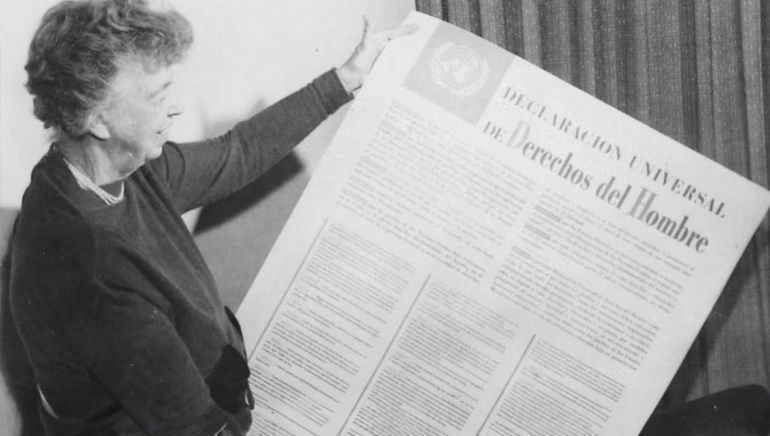
Eleanor Roosevelt holds up the Universal Declaration of Human Rights in Paris, 1948.
The Australian Connection
Read here for the significant role Australia played in the Universal Declaration of Human Rights.
Formed in the aftermath of the Second World War, the Universal Declaration of Human Rights was adopted by the newly-formed UN General Assembly in Paris on 10 December 1948. It is an aspirational international document that enshrines the rights and freedoms of all human beings.
The formation of both the United Nations and the Declaration have helped reshape our modern world, and Australia played a prominent role.
Australia was a founding member of the UN and was one of only eight nations involved in drafting the Declaration.
Dr Herbert Vere Evatt (1894-1965), the then-Foreign Minister of Australia, was extremely influential in the development of the Declaration's draft.
A revered scholar and former High Court judge, he was President of the General Assembly of the United Nations, the only Australian that has ever held that title, when the draft was adopted in Paris in 1948.
In 1945, Jessie Street (1889-1970) was the only female adviser in the Australian delegation to the United Nations Conference on International Organization, held in San Francisco.
In collaboration with other women, she secured the insertion of the word 'sex' in the clause 'without distinction as to race, sex, language or religion' wherever it occurs in the UN Declaration. This was pivotal to ensure women were equally recognised in the Document.
Find out more about this suffragette dubbed 'Red Jessie' by Australian media on the Jessie Street Trust website.
This site uses cookies to analyse traffic, remember your preferences, and optimise your experience. We use some essential cookies to make this service work. We’d also like to use analytics cookies so we can understand how you use the service and make improvements. For more information see our Privacy Policy.
Need help?
Have a question about discrimination or sexual harassment? Want to know more about human rights? Contact us if you need help.