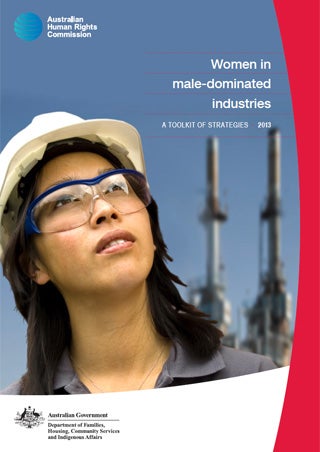
Women in male-dominated industries: A toolkit of strategies (2013)
Access practical strategies to increase women's representation in male-dominated industries with evidence-based recommendations for organisational leaders.
Summary
This toolkit is designed to assist leaders in organisations to develop and implement constructive and sustainable strategies to increase the representation of women in non-traditional roles in male-dominated industries. It provides practical suggestions and examples of different kinds of workplace strategies and mechanisms across four areas of: attraction, recruitment, retention and development of women.
Women in male-dominated industries: A toolkit of strategies (2013)
- PDF download 10.1 MB
- DOCX download 333.8 KB
This toolkit is designed to assist leaders in organisations to develop and implement constructive and sustainable strategies to increase the representation of women in non-traditional roles in male-dominated industries. It provides practical suggestions and examples of different kinds of workplace strategies and mechanisms across four areas of: attraction, recruitment, retention and development of women.
You can print the toolkit in a single document.
Complete toolkit as PDF [10MB](10.14 MB)
Complete toolkit as Word [334KB](333.85 KB)
You can also print individual chapters.
Each chapter focuses on a different area including:
Chapter 1: A Summary of Strategies Including practices to have an integrated gender diversity strategy.
PDF version [680KB](680.83 KB)
Word version [157KB](156.5 KB)
Chapter 2: Attraction To attract more women to consider and apply for opportunities within male-dominate industries.
- Job advertisements that attract women to apply
- Cases and content that inspire women
- Engagement activities that broaden the pool of potential applicants
Read the full chapter Read the full chapter
PDF version [2.2MB](2.21 MB)
Word version [164KB](164.5 KB)
Chapter 3: Recruitment For an inclusive and rigorous interview and selection process.
- Diverse and trained recruitment teams using merit based processes
- Broaden capabilities and pool of potential candidates
- Interaction with candidates to achieve a positive recruitment experience
Read the full chapter Read the full chapter
PDF version [2.5MB](2.5 MB)
Word version [152KB](151.5 KB)
Chapter 4: Retention To ensure more women are not only recruited but also retained in non-traditional roles.
- Workplace culture that is inclusive and embraces diversity
- Working environment that meets the needs of all employees
- Ongoing support for employees and families
Read the full chapter Read the full chapter
PDF version [2.4MB](2.4 MB)
Word version [161KB](161 KB)
Chapter 5: Development To ensure women have access to both formal and on-the-job development resulting in career paths in non-traditional roles.
- Senior leaders who are engaged in development
- Development that promotes the career advancement of women
- Merit based and inclusive talent process
Read the full chapter Read the full chapter
PDF version [1.8MB](1.77 MB)
Word version [160KB](160.5 KB)
Chapter 6: Additional Resources Some useful information and links for industry specific and general information on increasing the representation of women.
Read full chapter Read full chapter
PDF version [240KB](239.75 KB)
Word version [109KB](109 KB)
The photos included in this publication are simulated photos for demonstration purposes only and may not always fully comply with related work, health and safety standards. The Commission notes the importance of ensuring all employees on worksites are compliant with related work, health and safety standards. The photos included in this publication are simulated photos for demonstration purposes only and may not always fully comply with related work, health and safety standards. The Commission notes the importance of ensuring all employees on worksites are compliant with related work, health and safety standards.